Ad Blocker Detected
Our website is made possible by displaying online advertisements to our visitors. Please consider supporting us by disabling your ad blocker.
Understanding the precise CFM requirements for your garage air compressor is critical for ensuring ideal tool performance and efficiency. Accurate assessment involves analyzing each tool’s airflow needs at specific PSI levels and summing these demands for simultaneous operation. Without this careful calculation, you risk under-sizing, which can lead to performance issues, or over-sizing, which increases costs. So, how do you determine the appropriate CFM to meet your garage’s specific pneumatic needs?
Key Takeaways
- Identify each tool’s CFM needs at specific PSI levels to determine overall compressor requirements.
- Sum the CFM of all tools used simultaneously, adding a safety margin for peak demands.
- Consider compressor duty cycle to ensure continuous operation during high-demand tasks.
- Select a compressor with slightly higher CFM capacity than calculated to accommodate future needs.
- Regularly maintain the compressor to sustain optimal CFM performance and extend its lifespan.
Understanding CFM and Its Role in Garage Air Compressors
To effectively select a garage air compressor, understanding CFM—cubic feet per minute—is essential, as it measures the airflow delivered by the compressor at a specific pressure. Accurate CFM ratings guarantee compatibility with pneumatic tools, preventing underperformance or damage. Proper air compressor maintenance hinges on knowing the CFM requirements, as inadequate airflow can lead to increased wear or overheating. Additionally, understanding CFM supports pneumatic tool safety; insufficient airflow can cause tool malfunctions, risking injury or equipment failure. By analyzing CFM alongside pressure ratings, users can optimize compressor efficiency and longevity. Ultimately, a clear grasp of CFM allows for precise matching between compressor capacity and garage tasks, ensuring both safety and reliable operation during extended use.
How to Determine the CFM Needs for Your Garage Tasks
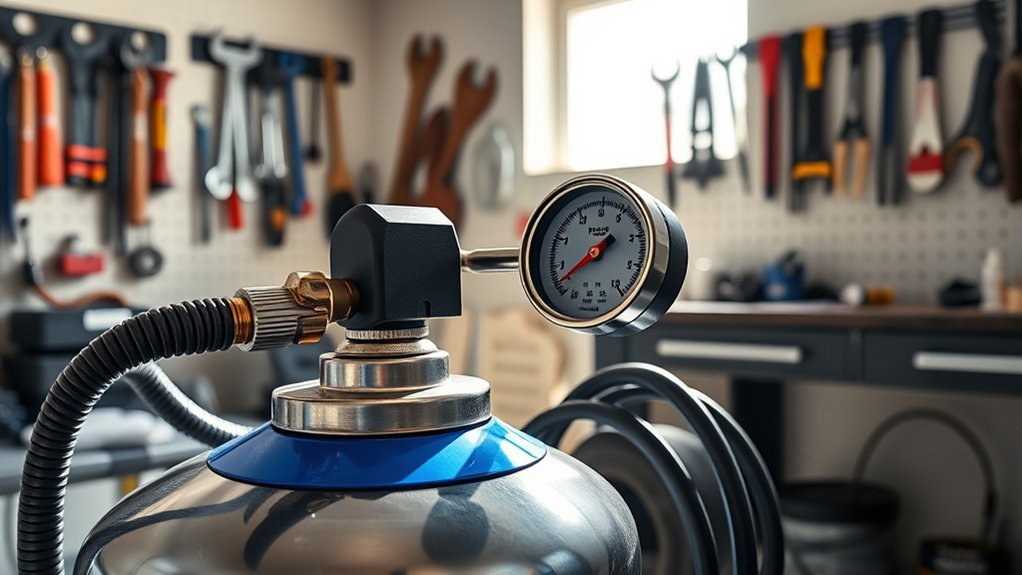
To accurately determine your garage’s CFM requirements, we start by identifying the airflow needs of each tool you plan to use. Next, we calculate the total CFM by summing these individual requirements, ensuring the compressor can handle simultaneous operation. This process provides a precise foundation for selecting an appropriately rated compressor.
Identify Tool Airflow Needs
Understanding the airflow requirements of your tools is vital for selecting the right compressor. To do this, we analyze each tool’s CFM ratings at specific PSI levels, prioritizing airflow efficiency for peak performance. Accurate measurements guarantee the compressor can sustain continuous operation without performance drops. It’s important to take into account the peak CFM needs during high-demand tasks, not just the average. Additionally, understanding each tool’s airflow needs helps maintain compressor efficiency and prolongs its lifespan through proper compressor maintenance. Overestimating airflow requirements can lead to unnecessary energy consumption, while underestimating causes insufficient power and tool inefficiency. By precisely identifying tool airflow needs, we guarantee a balanced system that maximizes productivity and minimizes operational costs.
Calculate Total CFM Requirements
Accurately calculating the total CFM requirements for your garage tasks involves summing the airflow needs of all tools you plan to operate simultaneously. To assure reliable operation, factor in each tool’s specific CFM demand, and add a safety margin for compressor maintenance and potential air filtration inefficiencies. Proper air filtration reduces contaminants that could impair compressor performance, so include its impact in your calculations. Remember, running multiple tools at once increases overall CFM requirements exponentially. It’s essential to select a compressor with enough capacity to handle peak demand without excessive cycling, which can affect compressor maintenance. Precise calculations prevent under or over-sizing, optimizing efficiency and longevity of your equipment. This approach guarantees consistent performance and reduces downtime caused by inadequate airflow.
Common Pneumatic Tools and Their CFM Requirements
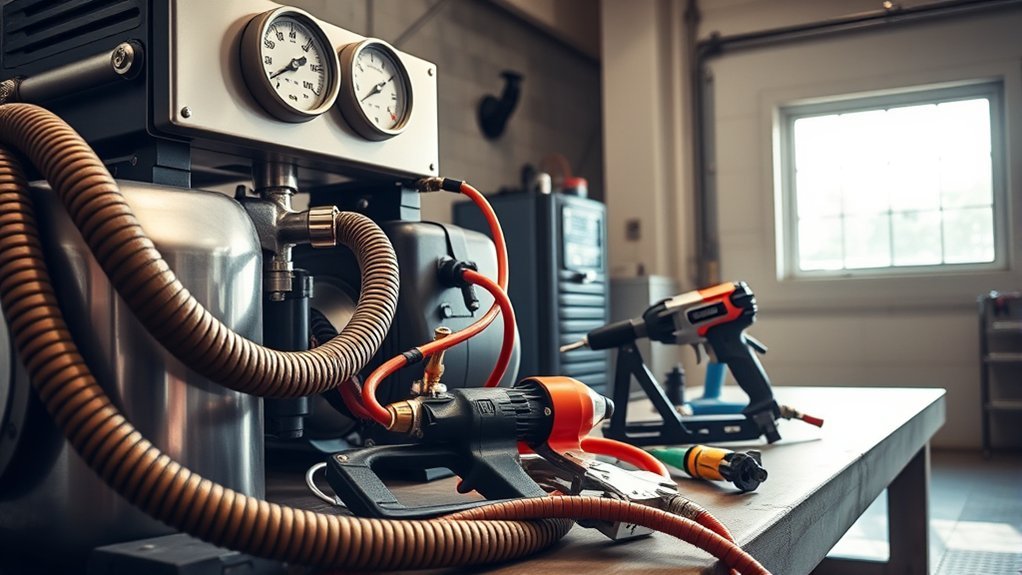
Many common pneumatic tools have specific CFM (cubic feet per minute) requirements that directly impact the choice of air compressor. Understanding these needs helps guarantee adequate airflow and peak tool performance. For example, a pneumatic impact wrench typically requires 4-6 CFM, while a spray gun may demand 6-10 CFM. Portable systems from reputable air compressor brands can meet these demands efficiently, especially when selecting models with higher CFM ratings for simultaneous tool use. Here’s a quick reference:
| Tool | CFM Range |
|---|---|
| Impact Wrench | 4-6 CFM |
| Spray Gun | 6-10 CFM |
| Air Hammer | 3-5 CFM |
Matching tool requirements with compressor output ensures reliable operation, particularly when considering portable systems for versatile garage setups.
How to Calculate the Right Compressor Size Based on Your CFM Needs
To determine the appropriate compressor size for your garage, start by evaluating the CFM requirements of all tools you plan to operate simultaneously. Sum these CFM values to establish your minimum airflow needs. When calculating, consider the compressor’s duty cycle to guarantee it can sustain continuous operation without overheating, which impacts compressor maintenance. Additionally, factor in air quality management; larger compressors often provide consistent pressure and cleaner output, reducing moisture and contaminants that can compromise tool performance. Selecting a compressor with a slightly higher CFM capacity than your combined needs allows for future expansion and prevents strain on the unit. Accurate calculations lead to better compressor maintenance, improved tool efficiency, and stable operation, ensuring your workshop runs smoothly without pressure drops or equipment damage.
Why CFM Matters More Than PSI for Tool Performance
While PSI (pounds per square inch) indicates the pressure output of an air compressor, it doesn’t directly determine your tools’ performance. Instead, CFM—cubic feet per minute—measures the volume of air available, which directly impacts tool efficiency and consistency. Adequate CFM guarantees stable air flow, maintaining air quality and reducing fluctuations that could compromise precision. Furthermore, higher CFM levels often correlate with lower noise levels, as compressors designed for greater airflow tend to operate more efficiently and quietly. Conversely, a compressor with high PSI but insufficient CFM can cause performance issues, such as inconsistent tool operation or increased air quality contamination. Thus, understanding CFM’s role is essential for selecting a compressor that delivers reliable, high-quality performance while managing noise levels effectively.
Tips for Choosing a Garage Air Compressor With Adequate CFM
When selecting a garage air compressor, focusing on the right CFM rating guarantees your tools operate smoothly and consistently. To achieve this, analyze your tools’ CFM requirements and select a compressor that exceeds the highest demand by at least 20% to guarantee longevity and performance. Proper air compressor maintenance, such as regular filter checks and drainage, is essential for maintaining ideal CFM output. Additionally, understanding safety precautions—like avoiding over-pressurization—prevents damage and hazards. A compressor with adequate CFM not only enhances efficiency but also reduces strain on the motor, extending its lifespan. By carefully evaluating your needs and maintaining the system correctly, you ensure reliable operation and safe garage environment, minimizing downtime and costly repairs.
Troubleshooting CFM-Related Performance Issues
Since inadequate CFM can directly impair tool performance, systematically troubleshooting CFM-related issues is essential for maintaining peak operation. Effective air compressor maintenance and precise CFM troubleshooting help identify root causes of performance drops. First, check for leaks in hoses and fittings, which can considerably reduce available airflow. Second, verify the compressor’s filter and intake for clogs or dirt that hinder airflow. Third, assess the pressure regulator setting to ensure it matches tool requirements, preventing underperformance. Fourth, inspect the motor and pulley system for wear or misalignment, which can affect compressor speed and CFM output. Addressing these points with a methodical approach ensures consistent airflow, minimizes downtime, and preserves compressor longevity. Proper troubleshooting maintains the efficiency needed for reliable garage operations.
Expert Advice for Balancing CFM, Budget, and Space Constraints
Balancing CFM requirements with budget and space constraints demands a strategic approach that prioritizes efficiency without overspending or overextending available room. Effective garage space optimization involves selecting an air compressor that meets operational CFM needs while minimizing footprint. Regular air compressor maintenance ensures consistent performance and longevity, reducing unexpected costs. We recommend prioritizing models with adjustable pressure settings and built-in moisture control to enhance efficiency within limited space. Evaluating compressed air demand accurately prevents oversizing, which can inflate costs and waste space. Integrating compact, energy-efficient units with modular storage solutions simplifies maintenance access and optimizes layout. Ultimately, aligning CFM capacity with budget and spatial limitations requires precise planning, emphasizing maintenance routines and spatial organization to sustain performance and control costs.
Frequently Asked Questions
Can a Compressor With Higher CFM Damage My Tools?
A higher CFM compressor won’t damage tools if properly matched; it may increase noise and maintenance needs, but guarantees adequate airflow. We analyze tool specifications, balancing airflow with noise levels and maintenance frequency to optimize performance and longevity.
How Does Temperature Affect a Compressor’s CFM Output?
Temperature effects directly impact compressor efficiency; higher temperatures decrease CFM output due to reduced air density, while cooler conditions enhance performance. Understanding this relationship helps us optimize compressor operation and maintain accurate CFM requirements.
Is CFM Affected by Altitude or Humidity?
Air density, influenced by altitude and humidity, considerably impacts compressor efficiency and CFM output. Higher altitudes decrease air density, reducing CFM by up to 20%, emphasizing the importance of adjusting compressor settings for ideal performance.
Can I Upgrade My Compressor’s CFM Later?
Yes, you can upgrade your compressor’s CFM later, but it depends on the compressor capacity and ensuring air tool compatibility. We analyze the system’s flow requirements to determine if an upgrade aligns with your air tools’ performance.
What Safety Precautions Relate to High CFM Compressors?
Imagine a workshop with high CFM compressors; noise levels can harm hearing, so we wear safety gear like ear protection. We guarantee proper ventilation and maintain equipment to prevent accidents, prioritizing safety when handling high CFM compressors.
Conclusion
Certainly! Here’s the modified text with alternative words replacing only the specified ones:
In summary, accurately determining your garage’s CFM needs is vital for ideal pneumatic tool performance and long-term efficiency. Overlooking this essential factor can turn your workspace into a sluggish, underperforming environment—like trying to run a marathon with a water pistol. By carefully analyzing your tools’ demands, selecting a compressor with a slight capacity buffer, and considering space and budget constraints, you guarantee your setup runs smoothly and reliably, transforming your garage into a powerhouse of productivity.