Ad Blocker Detected
Our website is made possible by displaying online advertisements to our visitors. Please consider supporting us by disabling your ad blocker.
While maximizing airflow seems straightforward, understanding the precise CFM needs of a two-stage air compressor requires a careful balance of technical factors. Unlike single-stage models, these systems deliver consistent pressure and efficiency only when properly sized for peak demand. As we explore the variables that influence CFM requirements, it becomes clear that accurate assessment isn’t just about capacity—it’s about ensuring reliable operation and long-term savings. Let’s examine what it takes to optimize your compressor’s airflow.
Key Takeaways
- Determine peak airflow demands during maximum load to size the compressor’s CFM capacity accurately.
- Consider the impact of pressure levels and fluctuations on required CFM for consistent performance.
- Account for intercooling and compression stages, which influence overall airflow efficiency and capacity.
- Measure actual CFM using calibrated flow meters and pressure monitoring during typical operations.
- Match compressor CFM output to application needs to ensure reliable performance and prevent under- or overcapacity.
What Is CFM and Why Does It Matter for Two-Stage Compressors?
Understanding CFM, or cubic feet per minute, is essential when selecting a two-stage air compressor because it directly measures the volume of air the compressor can deliver at a given pressure. Accurate CFM ratings are critical for airflow optimization, ensuring the compressor meets the demands of specific applications. Proper compressor sizing hinges on understanding these requirements; underestimating CFM can lead to insufficient airflow, while overestimating increases costs and energy consumption. In two-stage compressors, CFM influences the overall efficiency and performance, as it reflects the compressor’s capacity to sustain high-volume airflow under pressure. By analyzing CFM needs precisely, we can optimize airflow delivery and select a compressor appropriately scaled to handle workload demands, which is essential for reliable operation and long-term efficiency.
How Two-Stage Air Compressors Differ From Single-Stage Models in Airflow Delivery

Two-stage air compressors are designed to optimize airflow delivery by dividing the compression process into two separate steps, unlike single-stage models that compress air in a single chamber. This division allows for more controlled compression, reducing temperature rise and improving efficiency. The first stage compresses air to an intermediate pressure, which is then cooled via intercooling—this impacts air compressor lubrication, requiring more precise lubrication to manage heat and wear. Enhanced cooling also results in lower compressor noise levels, making these models quieter during operation. The staged process enables higher CFM output at consistent pressure, providing better airflow management for demanding applications. Overall, the two-stage design offers superior airflow delivery, optimized lubrication, and reduced noise compared to single-stage counterparts.
Factors That Influence CFM Requirements for Two-Stage Compressors
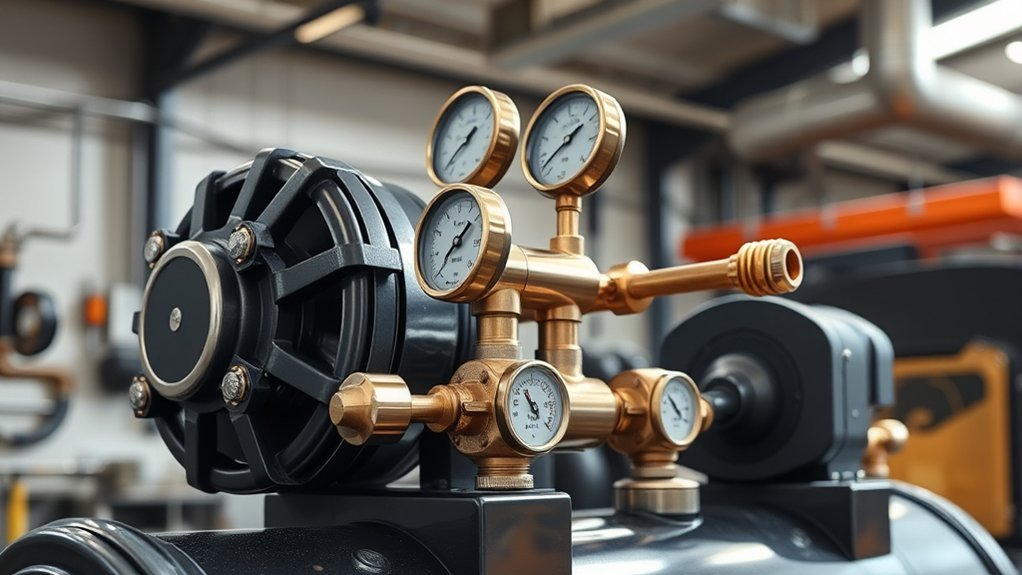
Several factors directly impact the CFM requirements of two-stage compressors, including load variability, operating pressure, and efficiency considerations. Variations in load demand can cause fluctuations in airflow needs, while higher operating pressures generally increase CFM demands. Additionally, compressor efficiency influences how effectively the unit meets airflow requirements under differing conditions.
Load Variability Effects
How does load variability impact the CFM requirements of two-stage air compressors? Fluctuations in demand cause changes in airflow needs, directly affecting compressor efficiency and performance. Sudden load increases can strain the system, leading to inconsistent air quality and elevated compressor noise levels. Conversely, low or intermittent loads may cause short cycling, reducing overall efficiency. Key effects include:
- Uneven air flow: Variability can cause pressure swings, impacting air quality and process stability.
- Increased compressor noise: Frequent cycling or load changes amplify noise levels, disturbing plant operations.
- Higher energy consumption: Sudden load spikes demand rapid response, increasing energy costs and wear on components.
Understanding these effects helps optimize CFM requirements, ensuring reliable operation despite load fluctuations.
Operating Pressure Influence
Operating pressure plays a crucial role in determining the CFM requirements for two-stage compressors, as it directly influences the volume of air the system must handle. Higher operating pressures increase the air volume needed, impacting air quality and noise levels. Elevated pressure settings often require more robust compression stages, which can generate more heat and noise, affecting overall system performance. Additionally, maintaining ideal air quality becomes more challenging at higher pressures, necessitating precise filtration.
| Operating Pressure | Effect on CFM | Impact on Air Quality | Noise Level Changes | System Efficiency |
|---|---|---|---|---|
| Low | Reduced | Easier filtration | Quieter | Less strain |
| Moderate | Balanced | Standard filtration | Moderate | Optimal |
| High | Increased | More filtration needed | Louder | Potential decline |
Compressor Efficiency Factors
Efficiency factors considerably influence the CFM requirements of two-stage compressors by affecting how effectively each compression stage operates under specific conditions. Key elements include air quality, which impacts compressor performance and longevity; noise levels, influencing operational comfort and environmental compliance; and internal component efficiency, dictating energy consumption and heat management.
Understanding these factors is essential for ideal system design. Specifically:
- Poor air quality, with contaminants or moisture, increases pressure drops and reduces CFM efficiency.
- Excessive noise levels may signal inefficiencies, leading to energy loss and increased maintenance.
- Component efficiency directly impacts air flow, with higher efficiency minimizing energy use and maximizing output.
Addressing these factors ensures reliable operation and precise CFM management for two-stage compressors.
How to Calculate Your CFM Needs Based on Your Application
To accurately determine your CFM needs, we start by calculating the air consumption rate of your equipment under typical operating conditions. Next, we assess the required operating pressure to guarantee the compressor delivers consistent performance. Finally, we estimate peak air demand to select a compressor that can handle fluctuating load requirements efficiently.
Determine Air Consumption Rate
Understanding your air consumption rate is essential for accurately determining the CFM (cubic feet per minute) requirements of your compressor. Accurate calculations guarantee ideal air quality, reduce unnecessary energy use, and minimize noise levels during operation. To determine this rate, consider:
- The specific application’s peak demand—knowing the maximum CFM needed helps prevent undersizing.
- Operational duration and frequency—continuous use increases cumulative air consumption, affecting compressor size.
- Air quality considerations—higher cleanliness standards may demand additional filtration, influencing airflow needs.
Assess Operating Pressure Needs
How do you determine the appropriate operating pressure for your application to accurately calculate CFM requirements? First, identify the minimum pressure needed to perform your tasks effectively, considering the specific tools or equipment involved. This operating pressure directly influences your compressor’s airflow demands, impacting energy efficiency and environmental impact. Higher pressures generally require more power, increasing carbon footprint and noise levels, which underscores the importance of optimizing pressure settings for noise reduction. Conversely, operating at the lowest effective pressure minimizes environmental impact without sacrificing performance. Accurate assessment of your pressure needs ensures your compressor operates efficiently, reducing unnecessary energy consumption and emissions. This balance is vital for sustainable operation, especially in settings where noise reduction and environmental considerations are priorities.
Calculate Peak Air Demand
Determining your peak air demand is essential to select a compressor that meets your application’s performance needs without excess capacity. Accurate calculation ensures ideal air quality, reduces noise levels, and prevents energy waste. To do this, we analyze the maximum airflow required during the most demanding cycle, considering factors like tool usage and operational duration.
Key considerations include:
- Identifying peak usage periods—when maximum CFM is needed to avoid underperformance or overcapacity.
- Factoring in air quality standards—ensuring the compressor supplies clean, dry air consistent with application requirements.
- Estimating noise impact—selecting a compressor that maintains acceptable noise levels during peak operation.
This precision guarantees efficiency, longevity, and compliance with air quality standards.
Understanding Pressure, Duty Cycle, and Their Impact on CFM
Pressure and duty cycle directly influence a compressor’s CFM output by dictating the operational parameters within which it functions. Pressure fluctuations impact CFM because as pressure increases, airflow capacity typically decreases unless the compressor is designed to compensate. Duty cycle considerations are critical because they determine how long a compressor can operate continuously without overheating or excessive wear. High pressure demands often lead to reduced duty cycles, requiring careful balancing to maintain consistent airflow. Understanding these factors helps us optimize compressor performance and avoid overload conditions. Accurate assessment of pressure variations and duty cycle limits guarantees the compressor operates efficiently within its specifications, providing reliable CFM output tailored to specific applications. This technical insight is essential for effective compressor selection and operation.
Common Mistakes When Estimating CFM for Two-Stage Compressors
Estimating CFM for two-stage compressors often involves common pitfalls that can lead to significant inaccuracies. Relying solely on historical trends without considering current industry standards can cause over- or underestimation of capacity needs.
Relying solely on historical trends can lead to inaccurate CFM estimates for two-stage compressors.
- Ignoring compressor efficiencies—overestimating actual output based on ideal conditions, which skews expectations.
- Disregarding real-world operating conditions—neglecting duty cycle and pressure fluctuations that impact CFM calculations.
- Failing to update assumptions—using outdated industry standards that no longer reflect modern compressor performance, leading to misinformed decisions.
These mistakes emphasize the importance of precise data and context-aware analysis. Accurate CFM estimation demands a clear understanding of evolving industry standards and historical trends, avoiding assumptions rooted in obsolete or incomplete information.
Tools and Techniques to Measure Actual CFM in Your Setup
To accurately measure the actual CFM in your setup, selecting the right tools and techniques is essential for obtaining reliable data. We recommend using a calibrated flow meter or digital manometer connected downstream of the compressor’s air filter, guaranteeing airflow is unimpeded. Monitoring pressure variations in the lubrication system can also provide indirect insights into compressor performance. Consistently check the air filter for blockages, as a clogged filter reduces airflow and skews measurements. Additionally, perform multiple readings under steady operating conditions to account for fluctuations. Use a stopwatch to time airflow over a fixed period, then calculate CFM precisely. These methods ensure you capture real-world airflow, enabling more accurate assessments of your two-stage compressor’s capacity and efficiency.
Selecting the Right Two-Stage Compressor Based on Your CFM Needs
Choosing the appropriate two-stage compressor hinges on accurately matching its CFM capacity to your specific application requirements. To do this effectively, consider these critical factors:
- Alignment with CFM Needs: Guarantee the compressor’s rated CFM exceeds your peak demand for reliable operation, minimizing stress on components.
- Air Compressor Lubrication: Proper lubrication reduces wear and maintains efficiency, supporting consistent airflow and prolonging equipment lifespan.
- Noise Reduction: Select models designed for noise minimization, which enhances workplace safety and comfort without sacrificing performance.
Matching CFM capacity precisely, while considering lubrication for durability and noise reduction for operator well-being, results in a compressor that’s both efficient and sustainable for your operation.
Adjusting and Maintaining CFM Performance Over Time
Maintaining consistent CFM performance in a two-stage air compressor requires ongoing attention to operational adjustments and routine upkeep. Regular monitoring of air quality is essential, as contaminants can impair compressor efficiency and skew CFM output. We recommend strict adherence to maintenance schedules, including filter replacements and lubrication checks, to prevent performance degradation. Proper maintenance ensures the compressor operates within ideal parameters, preserving airflow capacity over time. Adjustments may be necessary as components wear, especially in response to fluctuating demand or environmental factors. By systematically tracking performance data and addressing issues promptly, we can sustain stable CFM output, reduce downtime, and extend equipment lifespan. Ultimately, diligent upkeep and air quality management are crucial for reliable, efficient compressor operation.
Why Accurate CFM Assessment Saves You Time, Money, and Hassle
Accurate CFM assessment is essential because it directly influences operational efficiency and cost management. Misjudging airflow needs can lead to inefficient energy use, increased maintenance, and downtime. Applying principles from color theory helps us visualize airflow patterns and identify inefficiencies quickly, while understanding social dynamics within teams guarantees proper communication about system needs.
Accurate CFM assessment ensures efficiency, reduces costs, and prevents downtime by visualizing airflow and fostering team communication.
- Minimizing costs by avoiding over- or under-sizing equipment, reducing energy waste.
- Enhancing productivity through precise system calibration, preventing delays.
- Reducing hassle by preemptively addressing potential issues before they escalate.
Frequently Asked Questions
How Does Altitude Affect CFM Requirements for Two-Stage Compressors?
Altitude impact decreases CFM requirements for two-stage compressors, as air density drops. We recommend recalibrating compressors at higher elevations to maintain efficiency and performance, ensuring accurate airflow measurements and ideal operation despite reduced atmospheric pressure.
Can CFM Requirements Change Over the Lifespan of the Compressor?
CFM requirements can change over a compressor’s lifespan due to efficiency improvements and maintenance challenges. As components wear or are upgraded, airflow capacity may increase or decrease, necessitating ongoing monitoring to guarantee peak performance and prevent operational issues.
Are There Industry Standards for CFM Testing in Two-Stage Compressors?
We believe industry standards for CFM testing in two-stage compressors guide compressor maintenance and performance optimization. These standards guarantee accurate airflow measurements, helping us maintain efficiency, identify issues early, and optimize compressor operation throughout its lifespan.
How Does Ambient Temperature Influence CFM Performance?
Ambient temperature impacts CFM performance by affecting cooling efficiency, which influences compressor sizing. Higher temperatures reduce cooling efficiency, leading to decreased CFM output, so we must consider ambient conditions when designing or evaluating compressor capacity for ideal performance.
What Safety Considerations Are Linked to CFM Inaccuracies?
We recognize that CFM inaccuracies can lead to safety risks, so following strict safety protocols and regular calibration procedures guarantee precise airflow measurement, preventing equipment failure and maintaining safe operation standards in high-pressure environments.
Conclusion
In the end, ignoring your CFM needs is like trying to run a marathon in flip-flops—inefficient, risky, and ultimately futile. Properly sizing and maintaining your two-stage compressor isn’t just a technical detail; it’s the difference between reliable operation and costly downtime. So, let’s not leave airflow to chance. After all, accurate CFM assessment isn’t just smart—it’s the only way to keep your equipment running smoothly, efficiently, and without unnecessary drama.