Ad Blocker Detected
Our website is made possible by displaying online advertisements to our visitors. Please consider supporting us by disabling your ad blocker.
Understanding the precise CFM requirements for your workshop’s air compressor is critical to maintaining ideal tool performance and avoiding inefficiencies. Accurately evaluating airflow needs ensures you select a compressor that meets peak demands without excess capacity. This process involves a technical analysis of your tools, usage patterns, and future expansion plans, all of which influence your decision. To make informed choices, it’s essential to explore the key factors shaping your CFM calculations and how to align them with suitable compressor specifications.
Key Takeaways
- Determine the airflow needs of all tools by reviewing manufacturer specifications and calculating peak CFM during simultaneous use.
- Match compressor capacity to the workshop’s maximum CFM demand to ensure consistent tool performance.
- Consider factors like air quality, noise regulations, and operational duty cycles when assessing CFM requirements.
- Avoid undersized compressors that cause pressure drops or oversized units that waste energy and increase noise.
- Regular maintenance and system design optimize airflow delivery, efficiency, and air quality for workshop tools.
Understanding CFM and Its Importance in Workshop Air Tools
Understanding CFM (Cubic Feet per Minute) is essential because it directly measures the airflow a compressor can deliver, influencing the performance of workshop air tools. Adequate CFM ensures consistent operation without pressure drops, which affects tool efficiency. Additionally, CFM impacts air quality; a properly sized compressor maintains cleaner, drier air, reducing contaminants that compromise tool longevity. Noise levels are also connected, as higher CFM units tend to generate more noise, affecting the workshop environment. Selecting a compressor with suitable CFM balances airflow demands with noise control, ensuring safe and efficient operation. Ultimately, understanding CFM helps maximize air quality, minimizes noise pollution, and guarantees that workshop tools perform reliably under load.
How to Calculate Your Workshop’s Air Tool CFM Requirements
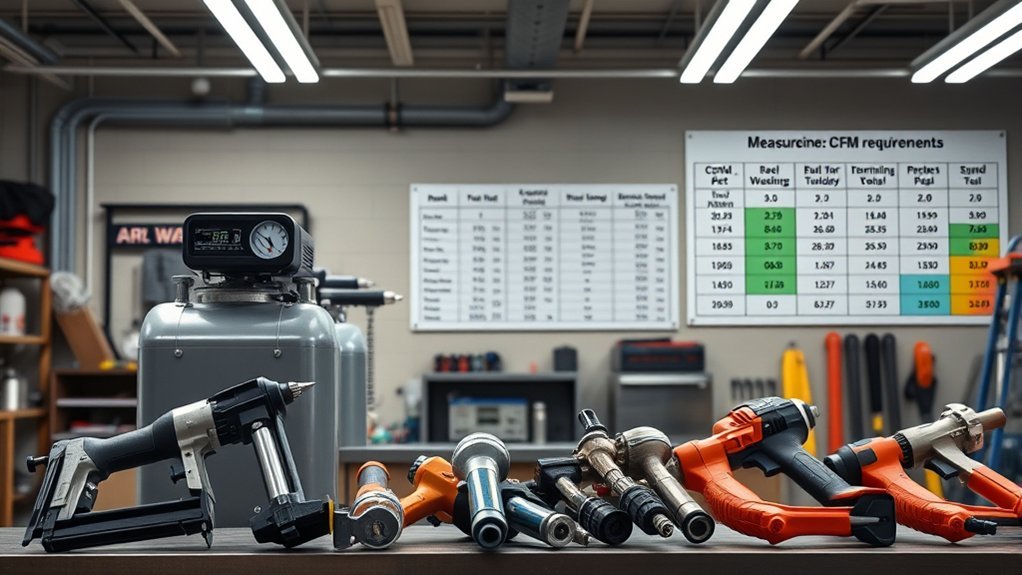
To accurately determine your workshop’s air tool CFM requirements, we need to analyze the specific airflow demands of each tool you’ll be using. This involves reviewing manufacturer specifications for airflow rates, ensuring consistent air quality, and accounting for simultaneous tool operation. By calculating the highest CFM needs during peak usage, we can size the compressor appropriately. A proper maintenance schedule is essential to sustain ideal air quality and prevent pressure drops that could skew calculations. Neglecting maintenance can lead to inaccurate airflow measurements, resulting in undersized or oversized compressors. Combining these factors allows us to establish a reliable CFM requirement, ensuring smooth operation, efficient air delivery, and minimal downtime in your workshop.
Factors That Influence Your CFM Needs in a Workshop
Several key factors directly impact the CFM needs of a workshop, requiring careful analysis to guarantee proper compressor sizing. Air quality requirements influence the compressor’s filtration and moisture removal capabilities, which can affect airflow demands. Poor air quality can necessitate additional filtering stages, increasing CFM requirements to maintain consistent pressure and flow. Noise levels are another critical factor; quieter operations may demand specialized, sound-reducing equipment, potentially influencing overall airflow capacity. Additionally, the number and type of tools, their simultaneous use, and operational duty cycles determine how much airflow is needed at peak times. Understanding these factors helps in selecting a compressor that secures optimal performance, maintains air quality standards, and adheres to noise regulations without overestimating or underestimating CFM needs.
Matching Your CFM Needs to Air Compressor Specifications
To effectively match your CFM needs to compressor specifications, we first need a clear understanding of CFM fundamentals and how airflow requirements translate to compressor power. We then evaluate whether the compressor’s airflow capacity aligns with your operational demands, ensuring sufficient airflow without oversizing. This precise matching optimizes performance and efficiency while preventing equipment strain.
Understanding CFM Fundamentals
Understanding CFM fundamentals is essential for selecting an air compressor that efficiently meets your operational demands. CFM, or cubic feet per minute, indicates airflow volume, impacting air quality and noise levels. Higher CFM rates typically support more extensive tools but may increase noise and compromise air quality if not managed properly. To optimize performance, consider the following:
| Key Factor | Impact on CFM Choice |
|---|---|
| Air Quality | Adequate CFM guarantees contaminant removal, maintaining air purity. |
| Noise Levels | Higher CFM compressors often produce more noise, affecting workspace comfort. |
| Application Needs | Match CFM to tool requirements for efficiency and safety. |
Matching these fundamentals ensures precise, efficient operation tailored to your workspace.
Matching Compressor Power
How do you guarantee your air compressor provides the right power to meet your CFM requirements? The key is aligning compressor size with your airflow needs, considering both air pressure and capacity. As CFM increases, so must the compressor’s power output, ensuring it can sustain the necessary airflow at the desired pressure. A compressor that’s too small will struggle to maintain consistent airflow, leading to pressure drops and performance issues. Conversely, an oversized unit may result in unnecessary energy consumption without added benefit. Precise matching involves analyzing your equipment’s demand profile and selecting a compressor capable of delivering the required CFM at your operating air pressure. This ensures efficient operation, minimizes wear, and optimizes energy usage, ultimately providing reliable, consistent performance.
Ensuring Adequate Airflow
Ensuring adequate airflow begins with accurately matching your equipment’s CFM requirements to your air compressor’s specifications. Proper matching prevents pressure drops that compromise air quality and increases noise levels, affecting workspace safety and efficiency. To determine suitable parameters, consider the following:
| CFM Requirement | Compressor Specification |
|---|---|
| 15 CFM | 15-20 CFM, ensuring stable airflow |
| 25 CFM | 25-30 CFM, maintaining air quality |
| 40 CFM | 40-50 CFM, minimizing noise and fluctuations |
Matching CFM ensures consistent airflow, optimal air quality, and controlled noise levels, crucial for precision work and worker safety. It’s essential to select a compressor that exceeds your maximum CFM needs slightly to accommodate fluctuations and future expansion without sacrificing performance.
Common Mistakes to Avoid When Choosing a Workshop Air Compressor
Choosing the wrong workshop air compressor can lead to significant operational inefficiencies and equipment failures. A common mistake is selecting a unit based solely on initial cost, neglecting factors like air compressor noise and long-term maintenance costs. Underpowered compressors cause frequent cycling, increasing wear and tear, which elevates maintenance expenses. Conversely, oversized units waste energy and may produce excessive noise, disrupting the workspace. Failing to account for the compressor’s duty cycle and load requirements can also lead to premature failure. Additionally, overlooking maintenance accessibility can escalate costs over time. To optimize performance and minimize costs, it’s essential to evaluate airflow needs accurately and select a compressor designed for the workload, balancing energy efficiency with durability, while also considering noise levels to guarantee a safe, productive environment.
Tips for Future-Proofing Your Workshop’s Air Supply
To future-proof your workshop’s air supply, it’s vital to adopt a proactive approach that accounts for both current and anticipated demands. Guaranteeing ideal air quality and adhering to a rigorous maintenance schedule are essential for consistent compressor performance. Proper filtration and moisture control prevent contamination, extending equipment lifespan and maintaining air quality. Regularly updating your system based on workload projections helps accommodate future tools and increased CFM needs. Monitoring system performance enables early detection of inefficiencies, reducing downtime. Additionally, planning for scalability by selecting modular components ensures your setup can grow without costly overhauls. Incorporate these strategies to maintain reliable airflow and safeguard your workshop’s productivity against evolving demands.
Additional Considerations for Optimizing Air Compressor Performance
Optimizing air compressor performance requires attention to several technical factors beyond basic capacity considerations. Energy efficiency plays a vital role, as selecting variable speed drives or optimizing load management minimizes power consumption. Noise reduction is equally important, achieved through soundproof enclosures and vibration isolators. To visualize these considerations:
| Factor | Impact | Optimization Example |
|---|---|---|
| Energy Efficiency | Reduces operational costs | Variable speed drives improve match |
| Noise Reduction | Enhances workspace environment | Acoustic enclosures and mufflers |
| Maintenance | Preserves performance and longevity | Regular inspections and part replacements |
| Air Quality | Ensures equipment and process integrity | Filtration and moisture control |
| System Design | Impacts efficiency and noise levels | Proper piping layout and sizing |
Focusing on these factors guarantees a reliable, efficient, and quieter workshop environment.
Frequently Asked Questions
How Often Should I Service My Workshop Air Compressor?
We recommend checking maintenance schedules regularly, ideally monthly, based on compressor sizing and usage. Preventive servicing guarantees peak performance, extends lifespan, and minimizes downtime, especially for high-CFM compressors demanding consistent, reliable operation in workshop environments.
What Is the Typical Lifespan of a Workshop Air Compressor?
A workshop air compressor’s lifespan typically spans 8-15 years, provided maintenance schedules are diligently followed. Its durability hinges on consistent upkeep, ensuring it remains a reliable workhorse rather than a fading shadow of its initial strength.
Can Multiple Air Tools Be Used Simultaneously With One Compressor?
Yes, multiple air tools can operate simultaneously if the compressor’s capacity and tool compatibility are sufficient. We analyze the combined CFM requirements against the compressor’s rated CFM to guarantee efficient, uninterrupted performance without overloading.
How Does Altitude Affect My Air Compressor’s CFM Performance?
At higher altitudes, our compressor’s CFM performance decreases due to thinner air, requiring altitude adjustments and recalibration. We analyze these effects to maintain ideal efficiency, ensuring our compressor operates accurately despite reduced atmospheric pressure.
Are Energy-Efficient Air Compressors Available for Workshops?
Yes, energy-efficient air compressors are available, utilizing advanced compressor technology that minimizes power consumption while maintaining performance. These models offer energy saving benefits, making them suitable for workshops seeking cost-effective, sustainable solutions.
Conclusion
In the end, accurately calculating your workshop’s CFM needs might seem tedious, but ignoring it could lead to costly downtime or subpar tool performance. It’s ironic how a simple oversight can undermine efficiency, yet many overlook this critical step. By carefully evaluating and matching your compressor’s capacity, you’re not just avoiding pitfalls—you’re ensuring long-term productivity. After all, in the world of air tools, precision isn’t just ideal; it’s essential for sustained success.