Ad Blocker Detected
Our website is made possible by displaying online advertisements to our visitors. Please consider supporting us by disabling your ad blocker.
Few decisions in industrial equipment are as impactful as choosing between stationary and portable air compressors, yet this choice can dramatically influence operational efficiency and cost management. The differences are nuanced but critical, affecting everything from project scope to long-term maintenance. Understanding these distinctions requires a careful, analytical approach, especially as the right selection can mean the difference between seamless productivity and costly inefficiencies. Let’s explore how each type aligns with specific project demands and operational goals.
Key Takeaways
- Stationary compressors are large, fixed units suitable for high-volume, continuous use; portable compressors are smaller and ideal for mobility.
- Stationary models typically offer higher energy efficiency and longer lifespan, while portable units are more cost-effective initially.
- Noise levels are generally higher in stationary compressors due to larger motors, whereas portable units tend to be quieter.
- Stationary compressors are best for industrial, manufacturing, and heavy-duty environments; portable compressors suit on-site, mobile tasks.
- Consider power source, capacity, and noise sensitivity when choosing between stationary and portable air compressors.
Understanding the Key Differences Between Stationary and Portable Air Compressors
While both stationary and portable air compressors serve the fundamental purpose of generating compressed air, their design and application differ markedly. Stationary units are typically larger, fixed installations optimized for high-volume output, often resulting in higher noise levels due to their substantial motors and cooling systems. In contrast, portable compressors prioritize mobility, usually featuring smaller motors and integrated noise-reduction measures, which generally lower noise levels. When it comes to energy efficiency, stationary compressors tend to be more efficient overall because they operate continuously at optimized loads, reducing energy waste. Portable models, however, may consume more energy per unit of compressed air due to frequent start-stop cycles and smaller motors. These differences substantially influence their suitability for various industrial and on-site applications.
What Are the Main Uses and Ideal Environments for Each Type?
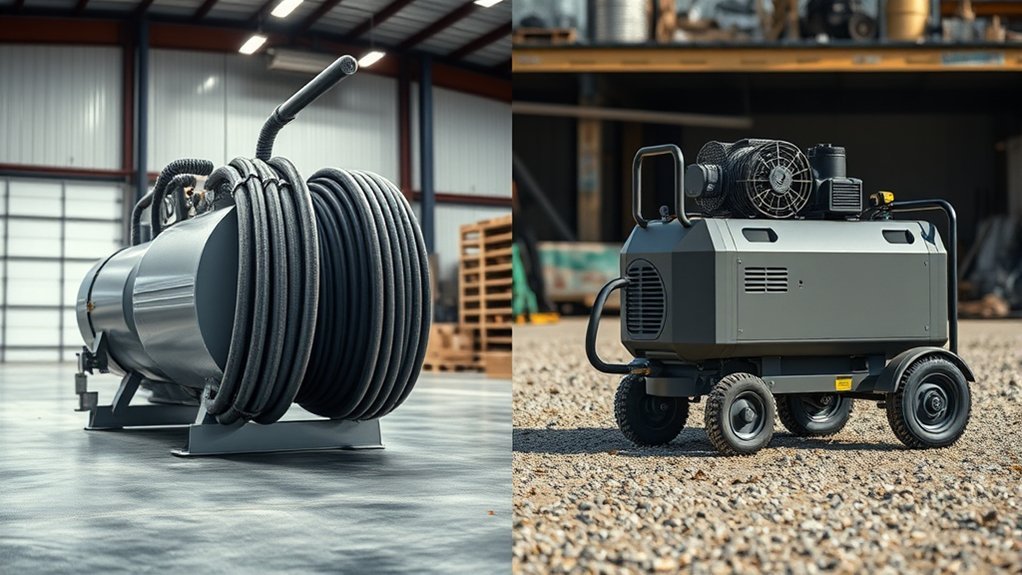
Stationary air compressors are primarily used in settings that require continuous, high-volume air supply, such as manufacturing plants, automotive workshops, and large-scale construction sites. These environments benefit from their stable operation and ability to support multiple tools simultaneously. Key considerations include minimizing air compressor noise and optimizing energy efficiency to reduce operational costs.
Stationary air compressors ensure stable, high-volume air supply for demanding industrial and construction environments.
The main uses and ideal environments for each type are:
- Manufacturing Facilities: Consistent, high-volume output with low noise disruption.
- Industrial Automation: Reliable power for automated systems, prioritizing energy efficiency.
- Heavy-Duty Construction: Continuous operation in rugged conditions with durable components.
- Large-Scale Workshops: Supporting multiple pneumatic tools while controlling noise levels and energy consumption.
How Do Cost, Maintenance, and Longevity Compare?
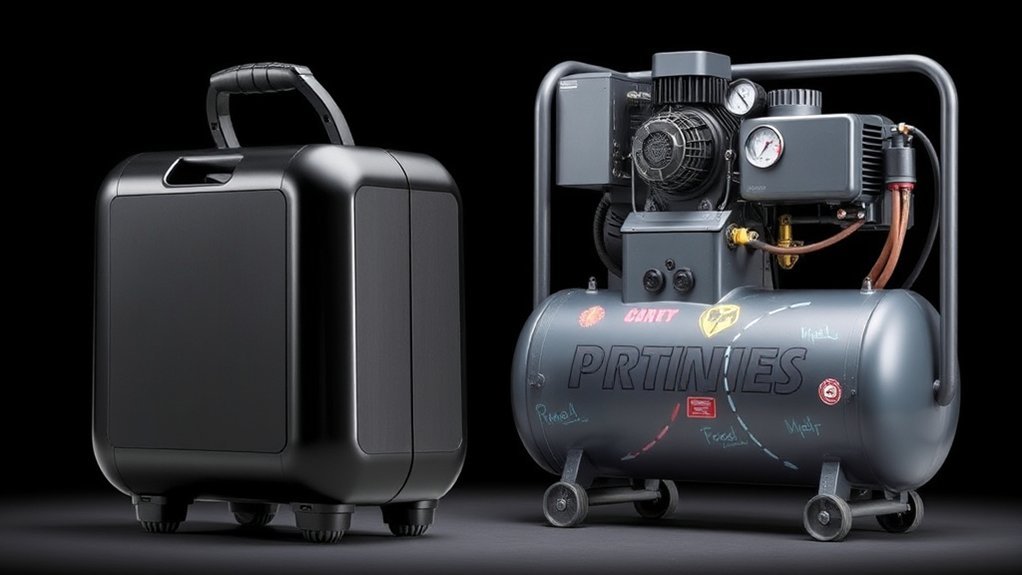
When comparing stationary and portable air compressors, evaluating their cost, maintenance, and longevity reveals significant differences driven by their design and intended use. Stationary units tend to have higher initial costs due to larger capacity and more robust construction, but they often offer better energy efficiency, reducing operational expenses over time. Maintenance for stationary compressors is typically more involved but less frequent, thanks to durable components designed for continuous use. In contrast, portable compressors generally have lower upfront costs, but their energy efficiency is often inferior, leading to higher running costs. Noise levels are also a key factor; stationary models usually operate more quietly, whereas portable units tend to be noisier, impacting their suitability in noise-sensitive environments. Longevity for stationary compressors generally surpasses that of portable units, which are designed for short-term or intermittent use.
Which Air Compressor Is Better for Your Specific Projects?
Choosing the right air compressor depends on the specific requirements of your projects, including factors like volume demands, portability needs, and operational environments. To determine the best fit, consider these key points:
- Air compressor capacity—select a unit with sufficient CFM for continuous operation or peak demands.
- Noise levels—opt for quieter models if working in noise-sensitive environments.
- Portability—portable compressors excel for on-site or mobile tasks, while stationary units suit fixed workshops.
- Operational environment—consider weather resistance and space constraints when choosing between models.
Evaluating these factors ensures your compressor matches project demands, optimizing efficiency and reducing operational issues related to capacity limitations or excessive noise.
Tips for Choosing the Right Air Compressor Based on Your Needs
Selecting the appropriate air compressor requires a thorough assessment of your specific operational needs and project parameters. We recommend evaluating the noise levels, especially if your workspace is noise-sensitive, as quieter models benefit indoor or shared environments. Additionally, consider your power sources; stationary compressors typically rely on dedicated electrical outlets, offering consistent power for high-demand tasks, while portable units often operate on standard outlets or batteries, providing flexibility. Analyzing your workload volume, pressure requirements, and mobility needs helps determine whether a stationary or portable model suits your operation. Matching these factors ensures peak performance, energy efficiency, and safety. By carefully balancing noise considerations and power source compatibility, you can select an air compressor tailored precisely to your project demands.
Frequently Asked Questions
Can Stationary Air Compressors Be Easily Relocated Once Installed?
Stationary air compressors aren’t easily relocated due to mobility challenges and installation complexities; they require significant effort, tools, and time to move, making portable units more practical for flexible, on-demand applications where relocation is frequent or necessary.
Are Portable Air Compressors Suitable for Industrial-Grade Tasks?
Portable air compressors can handle industrial-grade tasks, but their power capacity may limit them. They’re like nimble athletes overcoming mobility challenges, yet sometimes lack the sustained output needed for heavy-duty, continuous industrial applications.
What Safety Precautions Are Necessary for Both Types?
We prioritize safety gear like gloves and eye protection, and implement emergency procedures such as shut-off protocols and ventilation checks, ensuring both stationary and portable air compressors operate safely under high pressure, reducing risk of injury or equipment failure.
How Does Noise Level Differ Between Stationary and Portable Models?
Noise comparison reveals stationary compressors tend to produce higher sound levels due to powerful motors and larger casings, while portable models generally emit quieter noises, making them more manageable in confined or noise-sensitive environments.
Are There Environmental Considerations When Choosing Between Them?
We consider eco-friendly options and emission reduction when choosing between stationary and portable models, analyzing their energy efficiency and environmental impact. This helps us select compressors that minimize ecological footprints while meeting operational demands effectively.
Conclusion
Ultimately, choosing between stationary and portable compressors hinges on your project scope and operational demands. Notably, industrial settings favor stationary units, which account for over 60% of high-volume applications due to their durability and efficiency. By analyzing factors like initial investment, maintenance, and mobility, we can optimize performance and cost-effectiveness. Ultimately, a tailored approach ensures your air compression needs align with your specific project requirements, maximizing productivity and longevity.