Ad Blocker Detected
Our website is made possible by displaying online advertisements to our visitors. Please consider supporting us by disabling your ad blocker.
When comparing silent air compressors to standard models, it’s essential to analyze their technical features, operational environments, and overall efficiency. While silent compressors offer noise reduction and portability, they often come with limitations in airflow and higher initial costs. Conversely, standard compressors provide higher power and durability but at the expense of increased noise levels. Understanding these distinctions is vital for selecting the right equipment, especially in environments where noise levels and operational demands are critical factors.
Key Takeaways
- Silent compressors feature noise reduction technologies, making them ideal for noise-sensitive environments, while standard compressors lack these features and are louder.
- Silent models are more portable and compact but typically have lower airflow capacity suitable for light-duty tasks.
- Standard compressors deliver higher power for demanding applications but are noisier and less suited for enclosed spaces.
- Silent compressors generally require less maintenance due to sealed components and quieter operation.
- The choice depends on workspace noise requirements, portability needs, and the intensity of the compressor’s workload.
What Are the Key Differences Between Silent and Standard Air Compressors?
While both silent and standard air compressors serve the same fundamental purpose—producing compressed air—they differ markedly in design and operation. Silent compressors incorporate noise reduction technologies, such as sound-insulating enclosures and vibration dampening, which considerably lower operational noise. This design minimizes sound output, making them suitable for noise-sensitive environments. In contrast, standard compressors lack these features, resulting in higher noise levels. Maintenance requirements also differ; silent models often feature sealed components that reduce dust ingress, decreasing routine upkeep, while standard units typically demand more frequent cleaning and component checking. The quieter operation of silent compressors benefits indoor applications, but their specialized design can entail higher initial costs and more complex maintenance routines. These differences are critical in selecting the appropriate compressor for specific operational needs.
Pros and Cons of Silent Air Compressors for Indoor Use
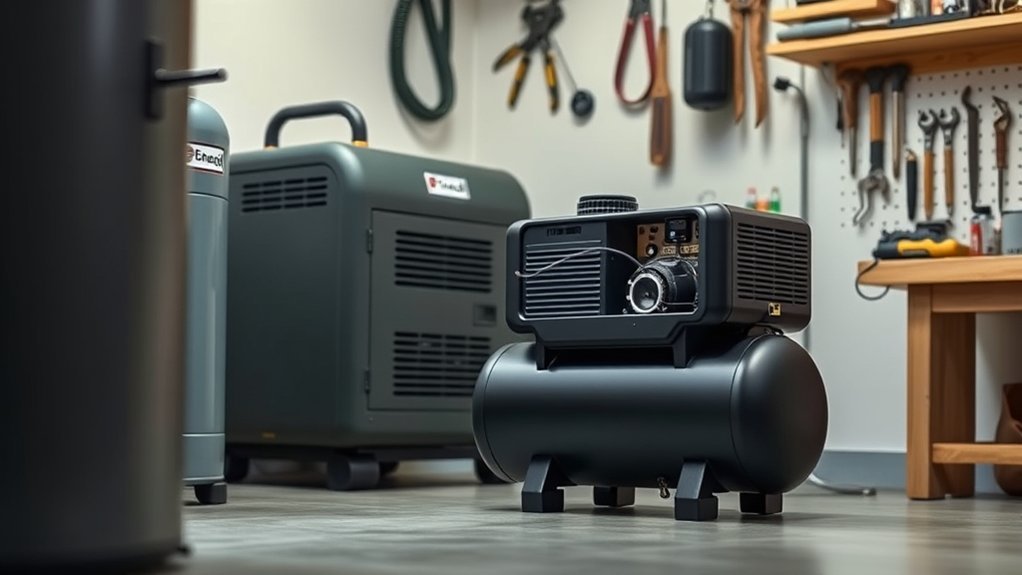
Silent air compressors are increasingly popular for indoor use because their reduced noise levels considerably enhance the working environment. This noise reduction minimizes operator fatigue and improves safety by reducing auditory distractions. Additionally, many models feature portability features such as compact design, lightweight construction, and integrated handles, making them easy to transport within confined spaces. However, these benefits come with some trade-offs. Silent compressors often have limited airflow capacity, which can restrict their use for heavy-duty tasks. Furthermore, the emphasis on noise reduction sometimes results in higher upfront costs and specialized maintenance requirements. While ideal for indoor applications demanding low noise levels, these compressors may not suit high-demand industrial environments where power and efficiency are prioritized over sound levels.
Advantages and Disadvantages of Standard Air Compressors for Power and Efficiency
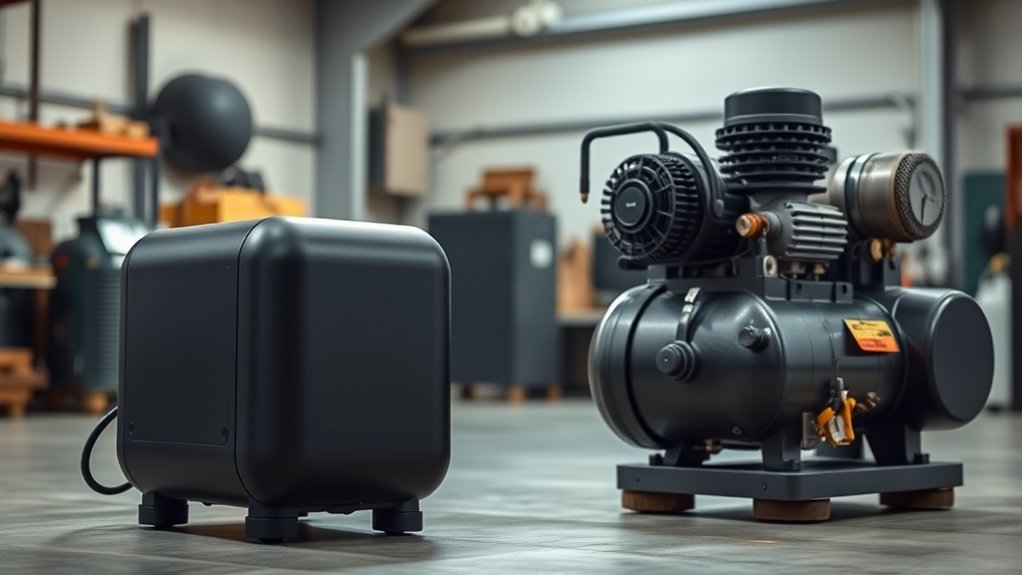
Standard air compressors are designed to deliver higher power output and greater efficiency, making them suitable for demanding industrial and construction applications. Their robust construction allows for continuous operation, which enhances productivity. However, this increased power often comes with higher maintenance costs due to complex components and frequent servicing needs. Additionally, their large size and weight create portability issues, limiting mobility across job sites. These compressors excel in scenarios requiring sustained high performance but can be less practical where frequent relocation is necessary. While their efficiency in energy use can reduce operational costs over time, the initial investment and ongoing maintenance expenses are significant considerations. Overall, standard compressors offer power and efficiency advantages that are offset by higher maintenance and portability challenges.
Which Type of Compressor Suits Your Workspace and Noise Level Needs?
Determining the appropriate compressor type depends heavily on your workspace environment and noise level requirements. Silent compressors excel in noise-sensitive settings, such as clinics or workshops, where reducing sound pollution is critical. They generally feature lower maintenance costs due to fewer moving parts and quieter operation, but may be less portable owing to their size and integrated design. Standard compressors, on the other hand, often offer superior portability with compact or wheeled models, making them suitable for mobile applications or smaller workspaces. However, their higher noise levels can be disruptive in enclosed or shared environments. When selecting, consider your need for quiet operation versus ease of movement, alongside long-term maintenance costs, to determine which compressor best aligns with your workspace’s technical and acoustic demands.
How to Choose Between a Silent and Standard Air Compressor: Factors to Consider
Choosing between a silent and a standard air compressor involves evaluating multiple technical and practical factors to guarantee it meets your specific operational needs. Critical considerations include noise reduction, energy efficiency, and overall performance.
To make an informed decision, consider:
- Noise Levels: Silent compressors excel in noise reduction, ideal for noise-sensitive environments, while standard compressors may produce higher decibel levels.
- Energy Efficiency: Silent units often incorporate advanced motor technology, offering better energy efficiency over extended use, reducing operational costs.
- Application Requirements: Assess your workload’s demands—continuous, high-capacity tasks may favor standard models, whereas intermittent or precision applications benefit from quieter operations.
Prioritizing these factors ensures maximum functionality aligned with your workspace and operational priorities.
Frequently Asked Questions
How Does Noise Reduction Affect Compressor Maintenance and Lifespan?
Noise insulation reduces vibrations and heat, which decreases maintenance frequency and minimizes wear. Consequently, this extends compressor lifespan, making silent compressors more reliable and easier to maintain over time, benefiting operational efficiency and long-term costs.
Are Silent Compressors More Energy-Efficient Than Standard Models?
Like a finely tuned orchestra, silent compressors excel in energy efficiency through superior noise insulation and vibration control, reducing energy waste. These technical advantages lead to smarter operation, lower power consumption, and extended equipment lifespan, benefiting users and environments alike.
What Are the Typical Cost Differences Between Silent and Standard Compressors?
We find that silent compressors generally have higher initial costs due to advanced noise reduction technology, but pricing factors like size and capacity influence the cost comparison, often making standard models more affordable upfront, yet potentially costlier long-term.
Can Silent Compressors Operate Effectively in Outdoor Environments?
Silent compressors can operate effectively outdoors due to their enhanced weather resistance and outdoor durability, but we recommend additional protective enclosures and regular maintenance to guarantee superior performance in variable environmental conditions.
How Does Compressor Size Impact Noise Levels and Performance?
We find that larger compressors, optimized with vibration reduction and noise insulation, tend to elevate noise levels slightly but enhance performance, while smaller units remain quieter and more portable, balancing efficiency and acoustic comfort for diverse applications.
Conclusion
Choosing between a silent and standard compressor depends on your workspace’s noise sensitivity and power demands. Picture a quiet workshop where tools hum softly in the background, or a bustling factory where noise is unavoidable. By analyzing airflow needs, budget, and environment, you can select the most suitable compressor. This decision shapes your efficiency, safety, and comfort—turning a technical choice into a strategic advantage that enhances your operational flow.