Ad Blocker Detected
Our website is made possible by displaying online advertisements to our visitors. Please consider supporting us by disabling your ad blocker.
Understanding the CFM rating of reciprocating air compressors is critical for ensuring ideal performance and reliability. It’s a precise measure of airflow capacity that directly impacts tool efficiency and equipment lifespan. However, selecting the right CFM involves more than just matching numbers; it requires careful analysis of application demands and operating conditions. Exploring these factors reveals important insights that can prevent costly mistakes and improve overall system effectiveness.
Key Takeaways
- CFM rating indicates the compressor’s airflow capacity in cubic feet per minute, essential for matching tool demands.
- Proper calculation of CFM involves analyzing specific airflow requirements and considering operational conditions.
- Higher CFM improves performance but may lead to increased noise and maintenance if oversized.
- Regular maintenance ensures the compressor maintains accurate CFM output and optimal efficiency.
- Selecting a compressor with the correct CFM prevents performance issues and enhances longevity.
What Does CFM Rating Mean for Reciprocating Air Compressors?
Understanding what the CFM rating signifies is essential when evaluating reciprocating air compressors, as it directly relates to their airflow capacity. The CFM rating indicates how much air the compressor can deliver per minute, influencing efficiency improvements and operational consistency. A higher CFM allows for greater productivity and better performance with demanding tools or processes. Proper assessment of CFM also informs maintenance scheduling; equipment operating at or near its maximum capacity may require more frequent inspections to prevent wear and ensure reliability. Recognizing this relationship helps optimize compressor use, reduce downtime, and extend lifespan. Ultimately, understanding the CFM rating enables informed decisions that balance airflow needs with maintenance strategies, ensuring the compressor operates efficiently over its service life.
How to Calculate the Right CFM for Your Air Tool or Application
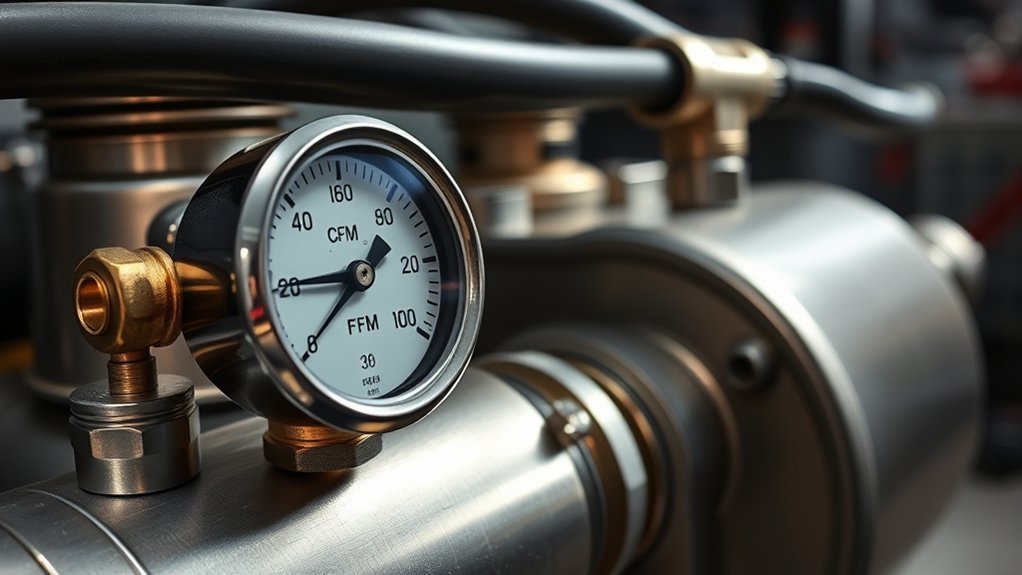
Determining the correct CFM for your air tool or application is crucial to guarantee peak performance without overloading your compressor. To do this accurately, analyze the tool’s specific airflow requirements, typically found on the manufacturer’s specifications. Confirm the compressor can meet or slightly exceed these CFM needs for continuous operation. Proper calculation involves evaluating the duty cycle and factoring in potential air leaks, which impact overall efficiency. Regular air compressor maintenance is essential to sustain accurate CFM output and prevent fluctuations that can increase compressor noise levels. Overestimating CFM can lead to unnecessary energy consumption and excessive noise, while underestimating causes performance issues. Precise calculation aligns your compressor’s capacity with your application, optimizing both operational efficiency and longevity.
Factors That Influence a Reciprocating Compressor’s CFM Performance
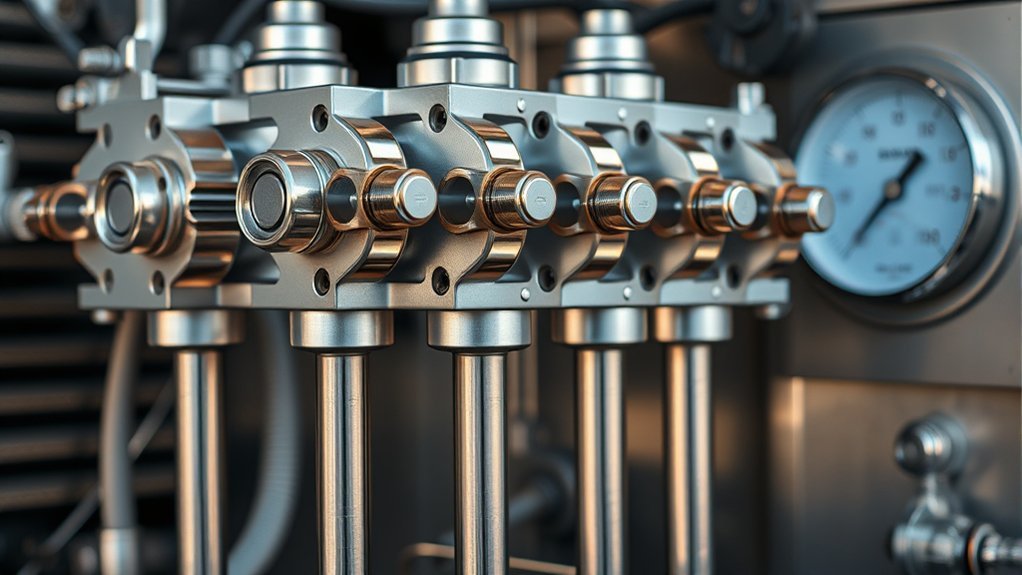
Several factors directly affect a reciprocating compressor’s CFM performance, and recognizing these variables is essential for accurate capacity assessment. Maintenance schedules play a critical role; poorly maintained units experience decreased efficiency, leading to reduced airflow output. Regular inspections, lubrication, and component replacements ensure peak operation and consistent CFM ratings. Noise levels also serve as an indicator of performance; elevated noise often signals mechanical issues or inefficiencies that can diminish airflow. Additionally, operating conditions such as inlet air temperature, pressure, and humidity impact CFM capacity. Variations in these factors can cause fluctuations in airflow, underscoring the importance of monitoring and controlling environmental parameters. By understanding and managing these factors, we can better predict compressor performance and maintain reliable airflow rates.
Tips for Choosing a Reciprocating Air Compressor Based on CFM Ratings
When selecting a reciprocating air compressor, matching the CFM rating to your application’s demand is crucial for peak performance and efficiency. To guarantee longevity and reliable operation, consider maintenance tips that keep the compressor running smoothly, such as regular lubrication and filter checks. Proper maintenance helps sustain accurate CFM output and minimizes downtime. Additionally, evaluate noise reduction features, especially if the compressor will operate in noise-sensitive environments. Higher CFM units tend to be louder; hence, choosing models with sound-dampening enclosures or vibration isolation can improve workplace comfort. By aligning CFM ratings with your specific airflow needs and incorporating maintenance strategies and noise mitigation, you maximize compressor performance while reducing operational costs and extending equipment lifespan.
Common Mistakes to Avoid When Considering CFM for Your Compressor
Are we accurately evaluating the true airflow needs of our applications? A common mistake is overestimating CFM requirements, leading to oversized compressors that increase maintenance issues and noise considerations. Conversely, underestimating CFM causes insufficient airflow, risking equipment failure and reduced efficiency.
To avoid these pitfalls:
- Rely on precise calculations rather than assumptions.
- Consider future expansion when sizing the compressor.
- Ignore the impact of intermittent demands on CFM needs.
- Overlook potential maintenance issues caused by operating at maximum capacity.
- Neglect noise considerations, which can be significant in oversized units.
Balancing airflow needs with operational reliability minimizes maintenance issues and noise disturbances—key factors in choosing the right CFM rating.
Frequently Asked Questions
How Does Altitude Affect CFM Ratings?
Altitude effects reduce air density, causing reciprocating air compressors to produce lower CFM ratings at higher elevations. As air density decreases, compressor efficiency drops, making it essential to adjust expectations and equipment for peak performance in varying altitudes.
What Maintenance Routines Improve Compressor CFM Output?
Think of your compressor as a finely tuned engine; regular maintenance like ensuring lubrication efficiency and filter cleanliness keeps it running smoothly, preventing restrictions, reducing wear, and ultimately improving CFM output through ideal performance.
Can a Compressor’s CFM Change Over Time?
Yes, a compressor’s CFM can change over time due to wear, oil lubrication degradation, or increased noise levels indicating internal issues, which can reduce efficiency and airflow, emphasizing the need for regular maintenance and performance monitoring.
How Does Temperature Impact CFM Performance?
Temperature impacts CFM performance primarily through thermal expansion, which reduces compressor efficiency. As temperatures rise, components expand, causing tighter clearances and decreased airflow, ultimately lowering the compressor’s effective CFM output and overall operational efficiency.
What’s the Difference Between Free Air Delivery and Rated CFM?
We see free air delivery reflects actual output under ideal conditions, while rated CFM accounts for real-world factors like lubrication efficiency and noise levels, which can reduce efficiency and affect the compressor’s performance and accuracy in delivering specified airflow.
Conclusion
Just as a compass guides us through uncharted waters, understanding CFM ratings steers us toward ideal compressor selection. By accurately evaluating your needs and considering influencing factors, we guarantee our equipment performs precisely when needed, avoiding pitfalls of over- or under-sizing. This deliberate approach aligns with the principles of precision and foresight—principles crucial for sustained efficiency and reliability. Ultimately, mastering CFM understanding empowers us to navigate the complexities of air compression with confidence and clarity.