Ad Blocker Detected
Our website is made possible by displaying online advertisements to our visitors. Please consider supporting us by disabling your ad blocker.
When it comes to choosing an air compressor, the decision often hinges on balancing initial investment against long-term value. While budget models may seem attractive at first glance, their limitations in durability and efficiency can lead to increased costs over time. Conversely, premium units promise reliability and advanced features, but require a higher upfront expense. Understanding these differences is essential for making an informed choice that aligns with your specific needs and operational demands.
Key Takeaways
- Premium compressors offer superior durability, advanced features, and energy efficiency, while budget models focus on basic functionality and lower upfront costs.
- Higher initial investment in premium units results in long-term savings through reduced maintenance and energy expenses.
- Premium compressors are better suited for industrial or continuous use, whereas budget options are ideal for small, intermittent tasks.
- Eco-friendly and energy-efficient features are typically found in premium models, minimizing environmental impact.
- Budget compressors may require more frequent repairs and have shorter lifespans, increasing overall operational costs.
How Do Budget and Premium Air Compressors Differ in Design and Build Quality
While both budget and premium air compressors serve the same fundamental function, their design and build quality differ considerably due to targeted manufacturing standards and material selection. Premium models typically feature superior construction, utilizing high-grade materials that enhance durability and stability. This results in lower noise levels, as their components are better insulated and balanced, reducing operational sound. Aesthetic design also plays a significant role; premium units often have sleek, ergonomic exteriors that facilitate easier maintenance and integration into professional environments. Conversely, budget compressors tend to use simpler, cost-effective materials that may compromise structural integrity and increase noise during operation. Their utilitarian aesthetic often prioritizes function over form, reflecting their affordability but also their limited design refinement.
What Features and Performance Levels Can You Expect From Budget vs. Premium Models?
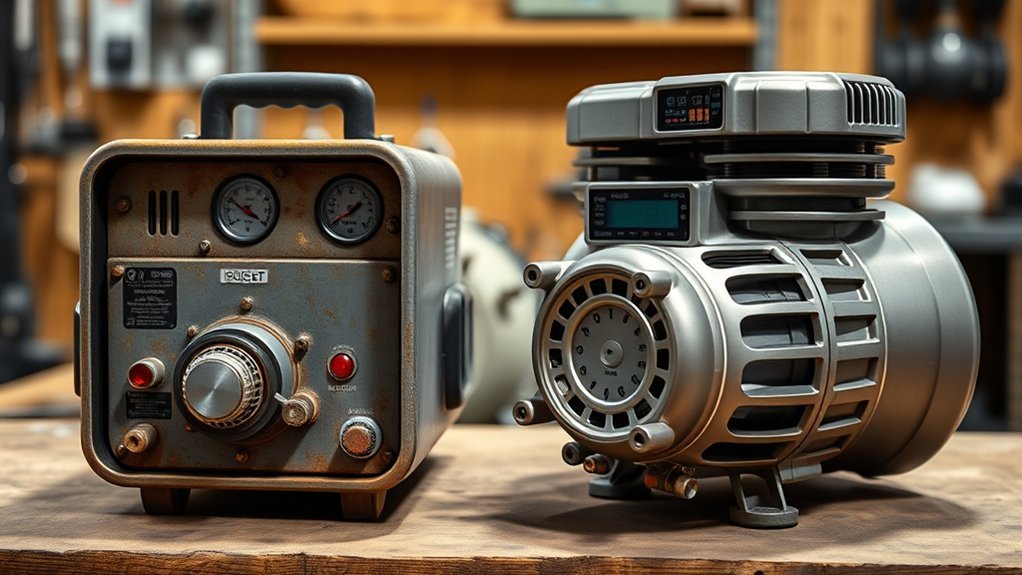
Budget and premium air compressors differ markedly in their features and performance capabilities, primarily reflecting their intended applications and price points. Budget models typically offer basic functionality with limited energy efficiency and higher noise levels, suitable for light tasks. In contrast, premium models emphasize advanced features, including:
Budget compressors are basic and noisy, while premium models offer efficiency, durability, and quieter operation for demanding tasks.
- Superior energy efficiency, reducing operational costs
- Lower noise levels, enabling quieter operation
- Higher CFM ratings for sustained performance
- Enhanced durability and build quality for longer lifespan
These distinctions directly influence their suitability for various environments. Premium compressors often incorporate quieter, more energy-efficient motors, while budget options prioritize affordability over noise mitigation and efficiency. Understanding these performance differences helps in selecting the right compressor for specific needs and operational demands.
How Pricing and Value Vary Between Budget and Premium Air Compressors
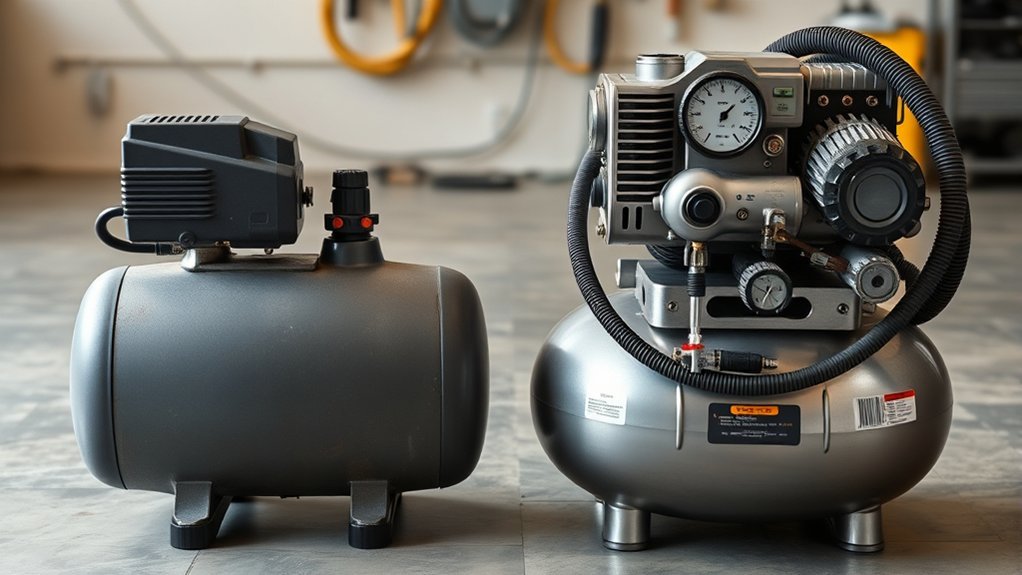
Pricing differences between budget and premium air compressors reflect significant variations in features and build quality, impacting initial investment. While premium models often command higher upfront costs, they tend to offer better long-term value through superior durability and lower maintenance expenses. Evaluating these factors helps clarify the true cost-to-benefit ratio for each option.
Price Differences and Features
Understanding the stark differences in price and features between budget and premium air compressors is essential for making an informed purchase. Price disparities often reflect core variances in energy efficiency, noise levels, durability, and advanced features. Premium models typically offer superior energy efficiency, reducing operational costs over time, while maintaining lower noise levels for a quieter workspace. Budget options, however, tend to compromise on these factors, prioritizing initial affordability. Key distinctions include:
- Higher initial cost for premium units
- Enhanced energy efficiency in premium models
- Lower noise levels with advanced soundproofing
- More durable construction and longer lifespan
These differences directly impact operational costs and user experience, making it crucial to consider both upfront investment and long-term value when evaluating options.
Long-Term Cost Benefits
While initial purchase price often captures immediate affordability, the true measure of value lies in long-term operational costs. Premium air compressors typically offer superior energy efficiency, reducing ongoing electricity expenses and lowering overall lifecycle costs. Their advanced design minimizes energy consumption, translating into substantial savings over time. Additionally, their optimized performance results in less wear and tear, decreasing maintenance and replacement costs. From an environmental standpoint, premium units tend to have a lower environmental impact due to reduced energy usage and emissions. Budget compressors, while cheaper upfront, often operate less efficiently, leading to higher energy bills and increased environmental footprint over their lifespan. Consequently, considering long-term cost benefits, investing in a premium compressor often provides better value through energy savings and reduced ecological impact.
Quality and Durability
Premium air compressors generally demonstrate higher standards of quality and durability compared to budget models, primarily due to their superior materials and engineering. This results in fewer design limitations that can compromise performance over time. Additionally, established brand reputation often correlates with stricter quality controls and reliable component sourcing, enhancing longevity. Budget models may use cheaper materials, leading to quicker wear and more frequent repairs. Conversely, premium units typically feature robust construction, precision-engineered parts, and better thermal management. Key indicators include:
- Higher-grade cast iron or aluminum components
- Enhanced thermal and vibration management systems
- Tighter manufacturing tolerances
- Stronger brand trust and warranty support
These factors collectively contribute to increased durability and sustained performance in premium compressors.
Which Applications Are Best Suited for Budget vs. Premium Air Compressors?
Selecting the appropriate air compressor depends heavily on the specific application requirements, as different tasks demand varying levels of performance, durability, and reliability. Budget compressors are suitable for light-duty tasks where portability and noise levels are critical, such as small workshops or DIY projects. Premium units excel in demanding environments, like manufacturing or continuous operation, where durability and consistent performance are essential. Consider the table below:
| Application Type | Suitable Compressor Type |
|---|---|
| Small, intermittent tasks | Budget compressors |
| Heavy-duty industrial use | Premium compressors |
| Portability needs | Budget compressors |
| Noise-sensitive environments | Budget compressors |
What Are the Long-Term Costs and Maintenance Considerations for Each Type?
Understanding the long-term costs and maintenance needs of air compressors is essential for making an informed investment. Premium models often feature higher energy efficiency, reducing ongoing operating costs, but may incur higher initial expenses. Budget compressors tend to have lower upfront costs but can result in increased energy consumption and frequent repairs. Maintenance considerations include:
Evaluating long-term costs helps choose between premium efficiency and budget affordability for air compressors.
- Energy efficiency: Premium units typically consume less power, lowering operational expenses.
- Noise levels: Higher-end compressors often operate more quietly, reducing noise-related costs and workplace disruption.
- Component durability: Premium models use higher-quality parts that last longer, decreasing repair frequency.
- Maintenance frequency: Budget models may require more regular service, increasing downtime and labor costs.
Balancing initial investment against these long-term considerations is vital for sustainable operation.
How to Decide Whether a Budget or Premium Air Compressor Is Right for Your Needs?
Deciding whether to invest in a budget or premium air compressor requires careful evaluation of your specific operational needs and financial constraints. Understanding the air compressor history reveals that premium models often incorporate advanced technologies designed for efficiency and durability, which can reduce operational costs over time. Additionally, considering environmental impact is essential; premium compressors typically feature better energy efficiency, minimizing carbon footprint. Budget models may suffice for short-term or low-demand applications, but they often lack the longevity and eco-friendly features of higher-end units. To determine the right choice, assess your workload, required airflow, and future expansion plans. Ultimately, balancing initial investment against long-term benefits will guide you toward the most suitable compressor type for your operational and environmental priorities.
Frequently Asked Questions
Are There Specific Brands Known for Reliable Budget or Premium Air Compressors?
We find that brands like Porter-Cable and Craftsman offer reliable budget air compressors with strong reputation and competitive prices, while Quincy and Ingersoll Rand lead in premium models, justified by their superior build quality and proven performance in price comparisons.
How Does Noise Level Typically Compare Between Budget and Premium Models?
Premium models generally offer lower noise levels due to superior sound insulation, making them quieter than budget options, which often lack effective soundproofing, resulting in higher noise comparison; this difference impacts operational comfort and workplace acoustics considerably.
Can Budget Compressors Handle Industrial-Scale Tasks Effectively?
Budget compressors generally struggle with industrial-scale tasks due to higher maintenance requirements, which increase operational costs. Cost considerations reveal they lack the durability and efficiency needed, making them less suitable for demanding applications compared to premium models.
What Are the Warranty Differences Between Budget and Premium Air Compressors?
We find premium air compressors offer longer warranties and better customer support, reducing maintenance costs over time. Budget models often come with limited warranties, prompting costly repairs and frustrating support, making them less economical for long-term industrial use.
Do Premium Compressors Offer Better Energy Efficiency Than Budget Options?
Premium compressors generally deliver better energy savings due to advanced motor designs and efficient components, reducing operational costs over time. Although initial investments are higher, the long-term cost implications favor premium models for energy-conscious applications.
Conclusion
In the end, choosing between a budget and premium air compressor hinges on your specific needs and long-term goals. While budget models may seem cost-effective initially, their limitations often align with lighter tasks, making them less suitable for demanding applications. Conversely, premium compressors, despite higher upfront costs, tend to deliver consistent performance and durability, ultimately saving you money and reducing downtime. It’s a clear case of initial investment aligning with sustained efficiency—coincidence or strategy, the choice is yours.