Ad Blocker Detected
Our website is made possible by displaying online advertisements to our visitors. Please consider supporting us by disabling your ad blocker.
When choosing between reciprocating and rotary screw air compressors, understanding their fundamental differences is essential for optimizing performance and cost-efficiency. Each type employs distinct mechanisms that impact their suitability for various applications, from small-scale tasks to large industrial operations. By analyzing their operational principles, advantages, and limitations, we can better determine which compressor aligns with specific needs—yet, the decision involves more nuanced considerations that warrant further exploration.
Key Takeaways
- Reciprocating compressors are simpler, suitable for high-pressure, intermittent tasks, but tend to be louder and require more maintenance.
- Rotary screw compressors provide continuous, steady airflow with lower noise levels and higher efficiency for large-scale, ongoing operations.
- Reciprocating units are more portable and cost-effective upfront, whereas rotary screw units have higher initial costs but lower operational expenses.
- Rotary screw compressors have fewer moving parts, offering greater durability and longer service intervals compared to reciprocating models.
- Choice depends on application needs: reciprocating for specific pressures and portability; rotary screw for continuous, high-volume, and quiet operation.
How Do Reciprocating and Rotary Screw Compressors Work?
Although both reciprocating and rotary screw compressors serve the same fundamental purpose of compressing air, they operate through markedly different mechanisms. Reciprocating compressors use pistons driven by a crankshaft within cylinders, compressing air through a series of intake and exhaust strokes. Their lubrication methods typically involve splash or pressurized oil systems to reduce wear and manage heat. In contrast, rotary screw compressors employ two meshing helical screws that rotate continuously, trapping and compressing air internally. Their lubrication is often provided via oil injection or spray, ensuring smooth operation and sealing. Regarding noise levels, reciprocating units tend to be louder due to piston movement and cylinder vibrations, while rotary screw compressors generally operate more quietly because of their continuous rotation and balanced design.
Comparing Performance: Efficiency, Capacity, and Reliability
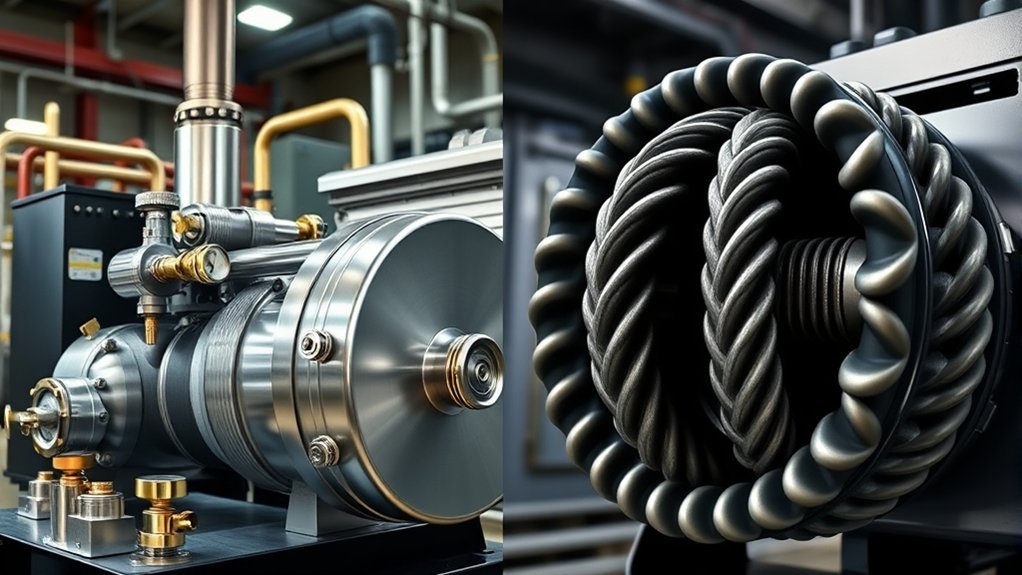
When comparing compressor performance, energy consumption is a key factor, with rotary screw units typically offering lower operational costs due to their continuous operation. Capacity variability varies between the two types, with reciprocating compressors providing higher pressure flexibility but at lower volumes, while rotary screws excel in steady, high-volume output. Additionally, maintenance demands and durability influence long-term reliability, as reciprocating models often require more frequent service, whereas rotary screws tend to have longer service intervals.
Energy Consumption Differences
How do reciprocating and rotary screw air compressors differ in their energy consumption, particularly regarding efficiency, capacity, and reliability? Reciprocating compressors typically exhibit higher noise levels due to their piston operation, leading to increased energy wastage through vibration and sound attenuation. They often have less efficient heat dissipation, resulting in higher power consumption during operation. In contrast, rotary screw compressors operate more smoothly, with continuous rotary motion that reduces noise and vibration, improving overall efficiency. Their design also simplifies installation, decreasing setup energy costs and ongoing maintenance. Reliability is enhanced in rotary screw units because of fewer moving parts, resulting in lower energy losses over time. Consequently, rotary screw compressors tend to be more energy-efficient and reliable in continuous operation, whereas reciprocating models are less efficient but may be suitable for intermittent use.
Capacity Variability
Capacity variability is a key factor distinguishing reciprocating and rotary screw compressors in operational performance. Reciprocating units typically exhibit higher capacity fluctuations due to their on/off cycling, affecting overall efficiency and reliability. Rotary screw compressors, by contrast, maintain a steadier output, which enhances capacity consistency, especially under variable demand. Noise levels are also impacted; reciprocating compressors tend to produce more noise during load changes, while rotary screws operate more quietly. Portability features further influence capacity management; portable units often favor reciprocating designs for ease of transport but sacrifice steady capacity. The table below summarizes these differences:
| Aspect | Reciprocating | Rotary Screw |
|---|---|---|
| Noise Levels | Higher | Lower |
| Capacity Stability | Fluctuates | Steady |
| Portability Features | Good | Limited |
Maintenance and Durability
Maintenance and durability profoundly influence the long-term performance of reciprocating and rotary screw compressors, with each design presenting distinct advantages and challenges. Reciprocating compressors typically require more frequent maintenance due to their complex piston systems, but they can be easier to service locally. Rotary screw units generally offer higher reliability and lower maintenance costs, thanks to fewer moving parts, though their installation demands more precise alignment and robust foundations. Noise levels differ markedly; reciprocating models tend to be noisier, necessitating sound attenuation measures, while rotary screws operate more quietly, reducing installation requirements for noise mitigation. Overall, rotary screw compressors exhibit greater durability and consistent efficiency over time, making them preferable for continuous operation, whereas reciprocating compressors may be more suitable where shorter, intermittent use is anticipated.
Which Compressor Suits Small vs. Large-Scale Tasks?
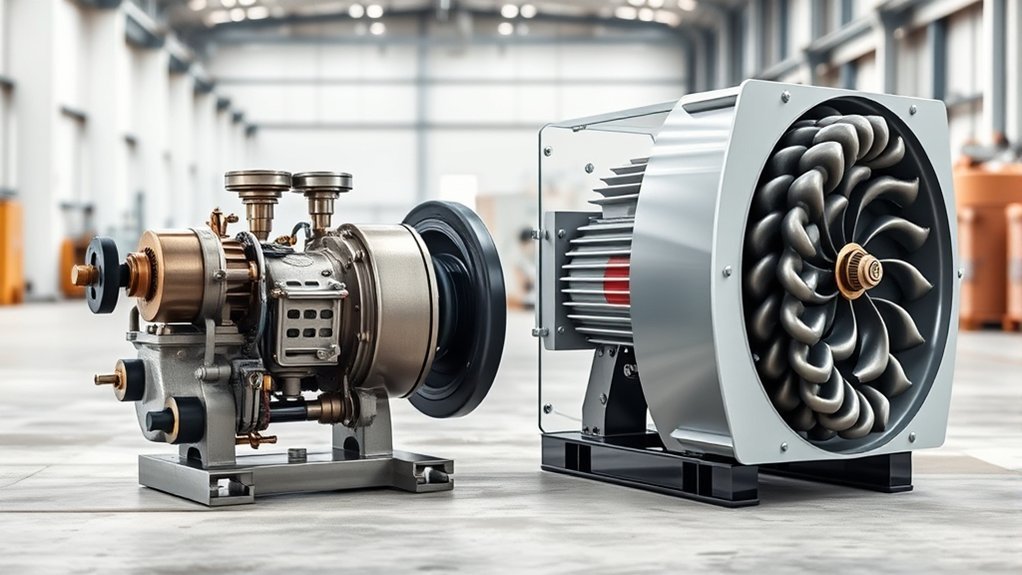
Choosing the right compressor depends on the scale of your operations; reciprocating units often excel in small, intermittent tasks due to their simplicity and flexibility. Conversely, rotary screw compressors typically deliver higher efficiency and continuous output, making them better suited for large-scale, demanding applications. Evaluating your specific workload and energy requirements is essential to optimize performance and cost-effectiveness.
Suitability for Small Operations
When evaluating suitability for small operations, reciprocating compressors often emerge as the more practical choice due to their modular design and ability to operate efficiently at lower capacities. They excel in environments where noise levels are a concern, as their quieter operation makes them suitable for confined or sensitive spaces. Additionally, portability concerns are minimized because these units are compact, lightweight, and easy to transport.
Key advantages include:
- Lower initial costs making them accessible for small-scale users.
- Ease of maintenance due to simpler components.
- Flexibility in operation, allowing quick adjustments for variable workload demands.
Efficiency in Large Tasks
For large-scale tasks requiring sustained high airflow and energy efficiency, rotary screw compressors typically outperform reciprocating models. They operate more smoothly, maintaining consistent pressure with lower noise levels, which minimizes disruption in continuous operations. Their design guarantees better heat dissipation, resulting in improved energy efficiency during prolonged use. Additionally, rotary screw compressors often offer superior portability options, such as integrated skid mounts or mobile frames, facilitating installation in expansive or dynamic work environments. In contrast, reciprocating compressors tend to generate higher noise levels and require more maintenance, making them less suitable for sustained, large-scale applications. Overall, for operations demanding continuous, reliable airflow with minimal operational noise and flexible setup, rotary screw compressors prove to be the more efficient choice.
Cost Considerations: Purchase Price, Maintenance, and Operating Expenses
Have you ever considered how the initial purchase price, ongoing maintenance, and operational costs influence the overall value of reciprocating versus rotary screw air compressors? Typically, reciprocating units have a lower upfront cost but incur higher maintenance and energy expenses over time. Conversely, rotary screw compressors tend to be more expensive initially, but their lower noise levels and reduced startup complexity lead to decreased operational costs. Specifically:
Reciprocating compressors are cheaper upfront but cost more over time; rotary screw units offer long-term savings despite higher initial prices.
- Reciprocating compressors often require frequent repairs, increasing maintenance costs.
- Rotary screw units benefit from higher efficiency, lowering energy consumption.
- Noise levels are notably lower in rotary screw models, reducing potential regulatory and health-related expenses.
Understanding these cost factors helps in selecting a compressor that balances initial investment with long-term operational savings.
Pros and Cons of Reciprocating Compressors
Reciprocating compressors are often chosen for their straightforward design and ability to deliver high-pressure outputs, but they come with specific advantages and drawbacks. One key advantage is their capacity for precise pressure control, making them suitable for applications demanding specific pressure levels. However, their lubrication requirements are significant; they rely on oil lubrication to reduce wear, which can lead to oil carryover if not properly managed. Noise levels are also a concern, as reciprocating units tend to generate high noise due to piston movement and valve operation. This noise can necessitate additional soundproofing measures, increasing installation costs. While their simplicity and high-pressure capability are attractive, these factors — lubrication demands and noise levels — can present operational challenges that must be carefully considered.
Pros and Cons of Rotary Screw Compressors
Rotary screw compressors offer a different set of advantages and challenges compared to reciprocating models. Their key benefits include consistent airflow and reduced vibration, which enhance operational stability. However, there are notable drawbacks:
- Noise levels tend to be lower than reciprocating compressors, making them suitable for noise-sensitive environments.
- Portability concerns arise because rotary screw units are generally larger and heavier, limiting ease of movement.
- The initial investment is typically higher due to complex design and advanced components, impacting budget considerations.
While their continuous operation and reduced maintenance are advantageous, the size and cost can be limiting factors, especially in applications where portability and upfront expenditure are critical.
Frequently Asked Questions
How Do Noise Levels Compare Between Reciprocating and Rotary Screw Compressors?
We find rotary screw compressors generally produce less noise due to superior sound insulation and design, whereas reciprocating models tend to be louder, but noise reduction options can mitigate sound levels in both types effectively.
Which Compressor Type Has a Longer Lifespan?
We find rotary screw compressors generally have a longer lifespan due to higher efficiency and smoother operation. Our efficiency comparison and cost analysis reveal they experience less wear and tear, making them more durable than reciprocating models over time.
How Easy Is Maintenance for Each Compressor Type?
Maintenance is like tuning a fine instrument; rotary screw compressors are easier due to consistent lubrication and temperature control, reducing downtime. Reciprocating units demand more effort for lubrication and temperature management, making maintenance more complex.
Are There Environmental Impacts Associated With Each Compressor?
We find that environmental impacts differ based on energy efficiency and compliance with regulations. Rotary screw compressors generally have lower emissions, aligning better with environmental standards, while reciprocating types may consume more energy, increasing their environmental footprint.
Can These Compressors Be Used in Portable Applications?
Yes, both reciprocating and rotary screw compressors can be used in portable applications, but we consider portable power needs and mobility considerations carefully to guarantee peak performance, ease of transport, and suitability for varying operational environments.
Conclusion
Ultimately, choosing between reciprocating and rotary screw compressors hinges on your specific needs. Reciprocating units excel in precision and portability for smaller tasks, while rotary screws deliver consistent performance for large-scale, continuous operations. As technology advances, the efficiency gap narrows, but the core differences remain. Do you prioritize upfront cost and flexibility, or long-term efficiency and durability? Making an informed decision ensures peak performance tailored to your operational demands.