Ad Blocker Detected
Our website is made possible by displaying online advertisements to our visitors. Please consider supporting us by disabling your ad blocker.
When selecting an air compressor, understanding the differences between vertical and horizontal configurations is vital, as each offers distinct advantages depending on operational needs and workspace constraints. Their design variations influence performance, maintenance, and suitability for specific tasks. To make an informed choice, it’s essential to analyze how these models align with your capacity requirements and environmental factors, which can considerably impact overall efficiency and long-term reliability.
Key Takeaways
- Vertical compressors are space-saving, suitable for small workshops, while horizontal models require more floor space and support high-volume use.
- Vertical units are more portable and easier to maintain, making them ideal for mobile or confined environments; horizontal units offer stability for continuous operation.
- Vertical compressors typically have higher initial costs but better heat dissipation; horizontal models are generally cheaper and support larger reservoirs.
- Vertical compressors tend to operate more quietly with less vibration, enhancing work environment comfort; horizontal units may produce more noise and vibration.
- Vertical designs are better for limited or uneven spaces, while horizontal compressors excel in supporting larger capacities and long-term stability.
How Do Vertical and Horizontal Air Compressors Differ in Design?
Vertical and horizontal air compressors primarily differ in their orientation, which influences their overall design and application. Vertical units tend to have a compact, space-efficient form, emphasizing streamlined design aesthetics suitable for confined environments. Their vertical layout often results in a taller profile, which can help with better weight distribution and stability. Conversely, horizontal compressors usually feature a broader, more stable base, making maintenance easier and reducing vibrations. When it comes to noise levels, vertical compressors often operate more quietly due to their enclosed design and reduced vibration transmission. Horizontal models, with their expansive footprint, may generate more noise but are generally easier to access for repairs. Overall, the design choices directly impact operational noise, aesthetic appeal, and suitability for specific workspace conditions.
Which Applications Are Best Suited for Vertical Air Compressors?
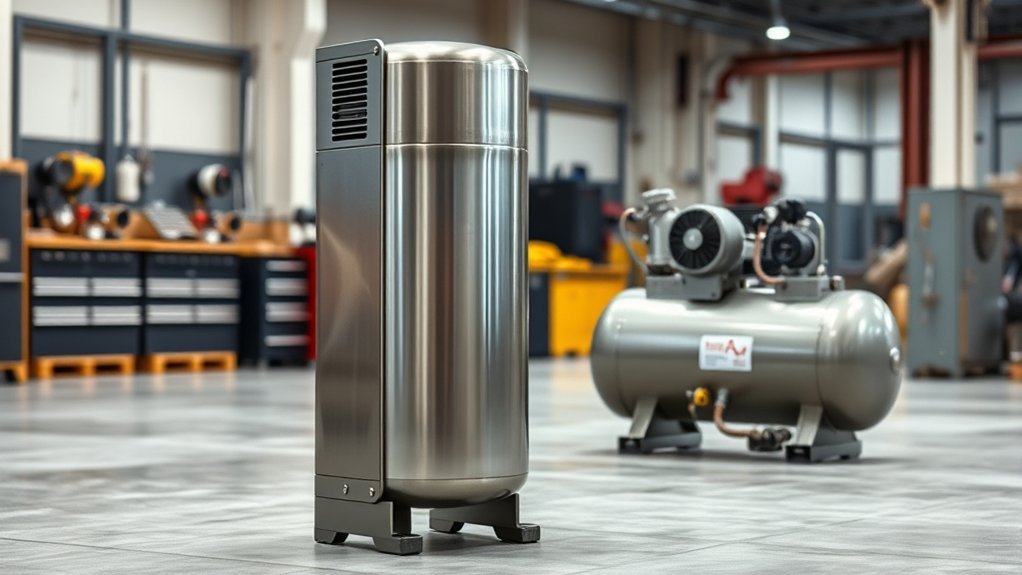
Because space constraints often dictate equipment choices, vertical air compressors are ideal for environments with limited floor space or where portability matters. They are particularly suited for small workshops, mobile service units, or tight industrial settings, as their compact design allows for easier installation and relocation. Additionally, vertical compressors typically produce lower air compressor noise levels due to their enclosed structures, improving work environment comfort. Their design can also enhance energy consumption efficiency by reducing heat loss and optimizing airflow within confined spaces. These characteristics make them well-suited for intermittent use or applications requiring quick setup and mobility. Overall, vertical air compressors excel where space savings, noise reduction, and energy efficiency are critical considerations for operational effectiveness.
When Should You Choose a Horizontal Air Compressor?
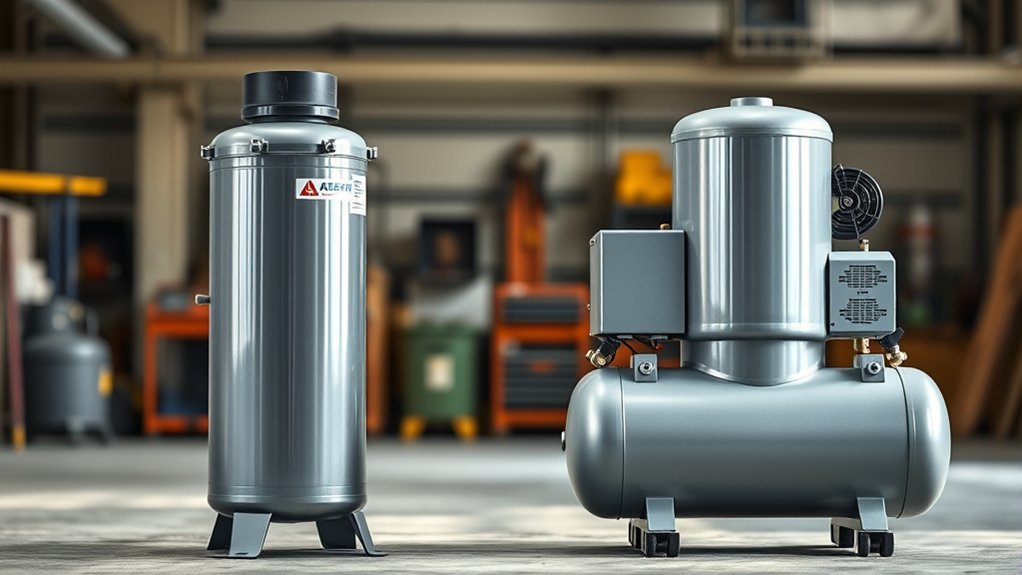
Horizontal air compressors are typically the ideal choice when stability, high capacity, and continuous operation are priorities. They excel in applications demanding consistent performance, where energy consumption efficiency and noise levels considerably impact operational costs and worker comfort. Horizontal models often have larger reservoirs, reducing cycling frequency and optimizing energy use. Their design also tends to distribute weight evenly, enhancing stability during long-term operation.
| Feature | Impact on Operation | Considerations |
|---|---|---|
| Energy Consumption | Lower due to stable, continuous running | Critical for cost-effective use |
| Noise Levels | Generally lower, more suitable indoors | Enhances workplace comfort |
| Capacity | Supports high-volume demands | Ideal for industrial settings |
Space and Portability: Comparing Vertical vs Horizontal Models
When evaluating space and portability, the physical orientation of an air compressor considerably influences installation flexibility and operational logistics. Vertical models typically occupy less floor space, making them suitable for confined areas, while horizontal units often require a broader footprint. This orientation impacts energy consumption, as vertical compressors generally have more efficient airflow paths, potentially reducing operational energy costs. Noise levels also vary; vertical compressors tend to produce less noise transmission through floors, benefiting environments where sound reduction is critical. Conversely, horizontal models may generate slightly higher noise levels due to their orientation and larger surface area. Overall, the choice hinges on spatial constraints and desired energy and noise performance, with vertical units offering advantages in space efficiency and quieter operation, and horizontal units providing stability and easier access.
Maintenance and Accessibility for Vertical and Horizontal Air Compressors
Maintenance and accessibility are critical considerations that considerably impact the overall efficiency and lifespan of air compressors. Vertical models often facilitate easier access to oil lubrication points due to their upright design, enabling straightforward maintenance procedures. Horizontal units, however, may require more effort to reach internal components, especially in confined spaces. Noise levels are also affected; vertical compressors tend to operate more quietly owing to better vibration absorption, whereas horizontal models may transmit more vibration and noise. The following table compares these aspects:
| Aspect | Vertical Compressor | Horizontal Compressor |
|---|---|---|
| Oil Lubrication | Easier access, simplified servicing | More effort needed for maintenance |
| Noise Levels | Generally quieter due to vibration damping | Typically noisier, vibrations transmitted |
| Accessibility | Improved, space-efficient design | Reduced, may need additional clearance |
Cost Considerations: Are Vertical or Horizontal Compressors More Budget-Friendly?
Determining which type of air compressor is more budget-friendly requires evaluating initial purchase costs, ongoing maintenance expenses, and long-term operational efficiency. Our cost analysis reveals that pricing factors such as design complexity and space requirements influence overall expenses. Vertical compressors often have higher upfront costs due to their specialized construction and foundation needs, but they can save space, reducing installation costs. Horizontal models generally have lower initial prices and simpler installation, making them more accessible for budget-conscious buyers. However, long-term operational costs, including maintenance and energy consumption, may vary based on configuration. Ultimately, examining these factors helps identify the more economical choice, with vertical units offering space savings that can offset higher initial investments, while horizontal units tend to be more cost-effective upfront.
Performance and Efficiency: Which Configuration Delivers Better Results?
Vertical and horizontal air compressors differ markedly in performance and efficiency, primarily due to their design configurations. Vertical models typically occupy less floor space and may offer improved heat dissipation, potentially reducing energy consumption. Horizontal compressors often have larger capacities and more stable operation, which can enhance overall efficiency for continuous use. Noise levels also vary: vertical units tend to generate quieter operation due to their compact design and enclosed structures, while horizontal units might produce higher noise levels, especially in larger models. When evaluating performance, it’s essential to ponder how each configuration influences energy use and sound emissions in your specific environment. Ultimately, the choice hinges on balancing space constraints, operational demands, and efficiency goals to achieve ideal results.
Durability and Longevity of Vertical vs Horizontal Air Compressors
While the design orientation of an air compressor influences many performance aspects, it also considerably impacts durability and longevity. Vertical compressors often feature a more compact structure, which can reduce exposure to external elements, potentially enhancing durability. Conversely, horizontal units tend to have larger surface areas, making maintenance and component access easier, possibly extending lifespan. Noise levels are generally lower in vertical models due to their enclosed design, which reduces vibration and sound transmission, thereby improving longevity. Aesthetic appeal also varies; vertical compressors are often favored for their sleek, space-efficient profile, which can minimize wear caused by environmental factors. Ultimately, both orientations can be durable if properly maintained, but design nuances influence long-term reliability and operational lifespan.
Choosing the Right Air Compressor Based on Your Workspace Size
Selecting the appropriate air compressor hinges considerably on the available workspace, as size constraints directly influence the type and capacity of units that can be effectively integrated. For smaller areas, vertical compressors often save space and reduce footprint, enabling easier placement without sacrificing capacity. Conversely, horizontal units may require more floor space but can accommodate larger tanks for higher volume needs. Additionally, workspace size impacts considerations like air compressor noise, since compact units generally operate more quietly, benefiting environments with limited ventilation. Environmental impact also factors in; smaller units often feature energy-efficient designs, reducing overall emissions and noise pollution. Ultimately, matching compressor type to workspace dimensions ensures ideal performance, minimized environmental footprint, and manageable noise levels, supporting both operational efficiency and workplace safety.
Pros and Cons Summary: Vertical vs Horizontal Air Compressors
When comparing vertical and horizontal air compressors, space efficiency, portability, and stability are key factors to contemplate. Vertical units generally save floor space and are easier to move, while horizontal models often offer enhanced stability during operation. Analyzing these aspects helps determine which configuration best aligns with specific workspace requirements and operational priorities.
Space Efficiency Differences
Have you considered how the orientation of an air compressor impacts its footprint in your workspace? Vertical compressors typically occupy less floor space, making them suitable for confined areas. Conversely, horizontal models often require a broader footprint but distribute weight more evenly.
- Vertical units optimize vertical space, reducing interference with workflow.
- Horizontal compressors may necessitate additional clearance for maintenance access.
- Noise levels can vary, with vertical models often generating less air compressor noise due to design.
- Environmental impact considerations include stability and vibration, which are influenced by orientation.
In terms of space efficiency, vertical compressors are advantageous for limited environments, but horizontal units might offer better stability and noise management in larger setups. Both orientations influence environmental impact through design-related noise reduction and vibration control.
Portability and Mobility
Ever wondered how the orientation of an air compressor influences its portability and ease of movement? Vertical compressors typically offer enhanced portability due to their compact footprint and lighter weight, making them easier to transport and maneuver in tight spaces. Conversely, horizontal models often have a broader base, which can hinder mobility but provide more stability during operation. Noise levels vary; vertical units tend to generate less noise during operation, contributing to better user comfort, while horizontal units may produce more sound due to larger power components. Additionally, the aesthetic appeal plays a role—vertical compressors usually have a sleeker, modern look that fits better in professional or workshop environments. Overall, the orientation directly impacts ease of movement, noise, and visual integration.
Stability and Placement
How does the orientation of an air compressor influence its stability and placement options? Vertical compressors generally offer superior stability due to a smaller footprint, making them suitable for limited spaces. Horizontal models, however, provide better weight distribution, which can enhance stability on uneven surfaces. When considering placement, vertical units are easier to position in tight areas and tend to have lower noise levels, reducing disturbance. Horizontal compressors often have a broader base, offering more stability on uneven floors but may be less aesthetic due to their larger horizontal profile.
- Vertical units conserve space and are easier to install in tight areas.
- Horizontal units provide enhanced stability on uneven floors.
- Noise levels tend to be lower with vertical compressors, minimizing disruption.
- Aesthetic appeal favors vertical models for modern, clean setups.
Frequently Asked Questions
Which Air Compressor Type Has Lower Noise Levels During Operation?
We find vertical air compressors generally have lower noise levels due to better sound insulation and reduced vibration, making them more effective at noise reduction during operation compared to horizontal models, especially in noise-sensitive environments.
How Do Vertical and Horizontal Compressors Impact Energy Consumption?
Vertical compressors often offer better energy efficiency due to optimized space and airflow, reducing operational strain. Horizontal models may incur higher maintenance costs over time, impacting overall energy consumption and operational expenses.
Are Vertical or Horizontal Compressors Easier to Upgrade or Expand?
Like building blocks, vertical compressors are easier to upgrade due to their compact, space-efficient mounting options, allowing for straightforward expansion. Horizontal models, while stable, typically demand more space and complex modifications for upgrades.
What Safety Features Are Typically Available for Each Compressor Orientation?
We find that both compressor orientations include safety features like vibration damping for stability and secure mounting, reducing risk of accidents. Vertical units often offer enhanced stability, while horizontal models excel in vibration control, ensuring safer operation overall.
How Does the Weight Distribution Affect Transportation and Installation?
Ever wondered how weight distribution influences transportation logistics? Vertical compressors, with centralized weight, simplify handling but require stable supports, while horizontal compressors distribute weight evenly, affecting transport stability and installation procedures, ultimately impacting operational efficiency and safety.
Conclusion
Ultimately, selecting between vertical and horizontal air compressors hinges on evaluating space, capacity, portability, and operational demands. Weighing their design efficiencies, application suitability, maintenance ease, and long-term durability allows us to make informed decisions. Recognizing the inherent trade-offs, we can optimize performance, reduce downtime, and guarantee cost-effectiveness. By aligning our choice with specific workspace requirements and workflow priorities, we empower ourselves to achieve reliable, efficient compressed air solutions tailored to our unique industrial or workshop environments.