Ad Blocker Detected
Our website is made possible by displaying online advertisements to our visitors. Please consider supporting us by disabling your ad blocker.
We compare efficiency and cost, examine operational principles and maintenance needs, and analyze application suitability—each factor influencing the choice between rotary screw and piston compressors. Both options serve specific industrial demands, yet their long-term performance and initial investment differ markedly. To determine which aligns best with your operational requirements, understanding their distinct advantages and limitations is essential. This exploration will clarify which compressor type offers the most favorable balance for your application.
Key Takeaways
- Rotary screw compressors deliver continuous, steady airflow ideal for high-volume, industrial applications, while piston compressors produce pulsating air suitable for intermittent tasks.
- Rotary screw units are more energy-efficient and cost-effective long-term despite higher initial purchase costs compared to piston compressors.
- Piston compressors require more maintenance, generate higher noise levels, and have a shorter lifespan than rotary screw compressors.
- Rotary screw compressors operate quieter, produce fewer emissions, and are better suited for noise-sensitive and environmentally conscious environments.
- Piston compressors are typically lower-cost upfront and ideal for small-scale, low-volume, or maintenance-specific applications.
What Are Rotary Screw and Piston Compressors? An Overview
Rotary screw and piston compressors are two fundamental types of positive displacement air compressors, each employing distinct mechanisms to compress air efficiently. Rotary screw compressors utilize interlocking helical screws, offering continuous operation with minimal pulsation, which influences compressor lubrication by requiring specialized, high-quality oil to reduce wear and manage heat. Piston compressors operate through reciprocating pistons within cylinders, generating pulsating airflow and typically producing higher noise levels. This noise is often linked to vibration and mechanical impact, necessitating sound attenuation measures. Lubrication strategies differ considerably: rotary screws demand constant, precise lubrication for seamless operation, while piston compressors require effective lubrication to minimize friction and component wear during cyclical motion. These differences directly impact maintenance complexity, operational noise, and lubrication system design.
How Do Rotary Screw and Piston Compressors Work? Operating Principles Explained
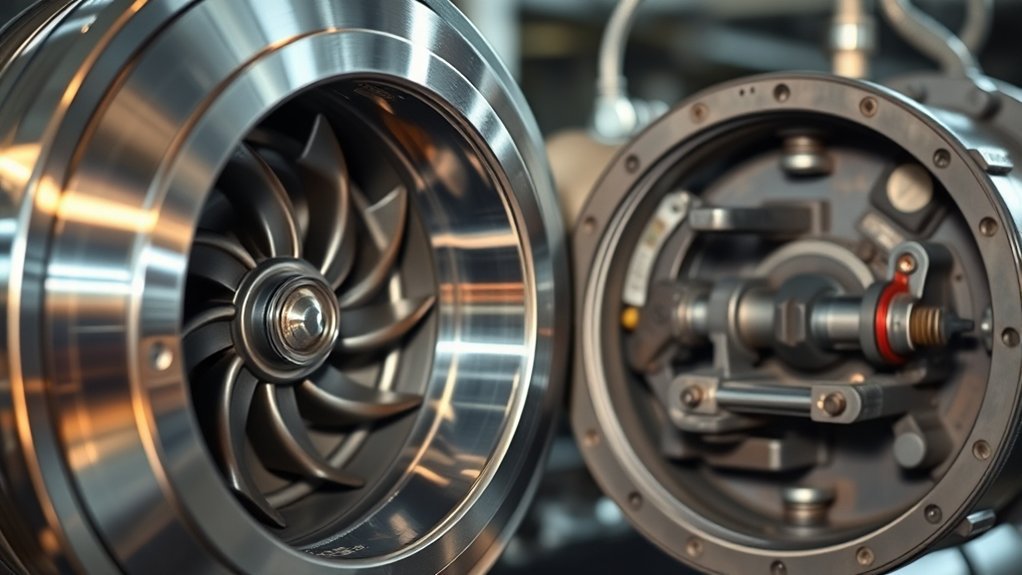
To understand how rotary screw and piston compressors operate, it’s paramount to examine their core mechanisms, which convert mechanical energy into compressed air through different processes. Rotary screw compressors use two meshing helical screws that trap and compress air as they rotate, providing continuous, steady airflow. In contrast, piston compressors employ cylinders and pistons driven by a crankshaft, compressing air in discrete strokes, resulting in pulsating airflow. These differing methods influence noise levels, with piston compressors typically producing higher noise due to their reciprocating parts. Additionally, the operating principles impact environmental impact; rotary screw units generally have lower emissions and energy consumption, making them more environmentally friendly. Understanding these mechanisms helps clarify their suitability for various applications based on operational characteristics.
Comparing Efficiency: Which Compressor Type Uses Less Energy?
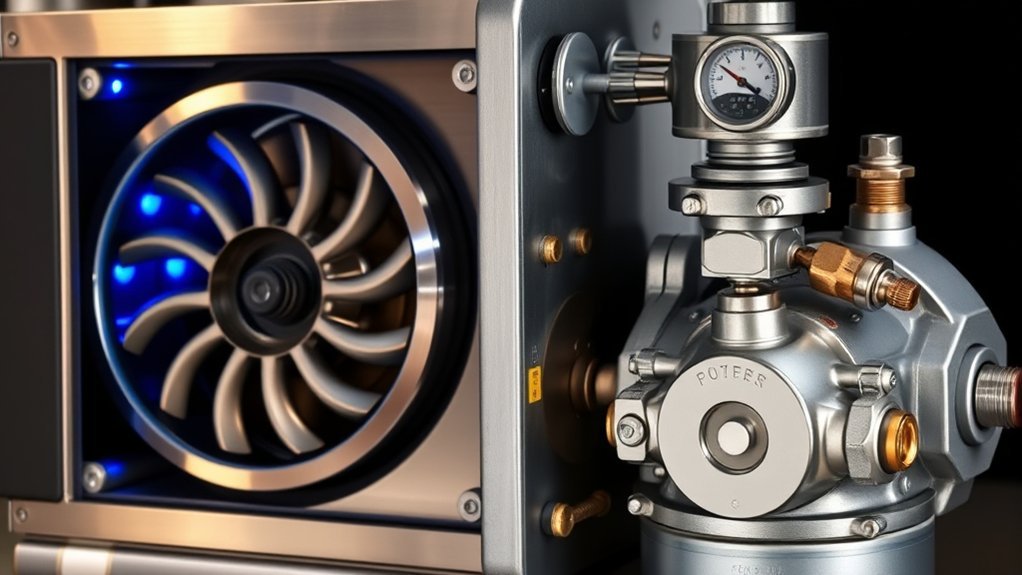
When comparing energy consumption between compressor types, it becomes evident that efficiency depends heavily on application conditions and operational parameters. Rotary screw compressors generally demonstrate higher power efficiency in continuous operation, owing to their ability to maintain a stable output with minimal fluctuations. Their design allows for more consistent energy consumption, reducing peak loads. Conversely, piston compressors typically exhibit higher energy consumption due to intermittent cycling and higher mechanical losses during start-up and shut-down phases. Over extended periods, the energy efficiency of rotary screw units tends to surpass that of piston models, especially in applications requiring constant airflow. As a result, for scenarios prioritizing lower energy consumption, rotary screw compressors often present a more effective choice, optimizing power efficiency through continuous, stable operation.
Maintenance and Durability: What Are the Long-Term Care Needs?
Regular maintenance is essential to guarantee long-term operational reliability and to maximize the lifespan of compressor units. Rotary screw compressors generally require consistent lubrication to maintain peak performance, with lubrication requirements involving synthetic or mineral oils that must be monitored for contamination and viscosity stability. Proper lubrication reduces wear on gears and bearings, extending durability. Piston compressors, on the other hand, demand regular oil changes and precise adjustments due to their reciprocating nature. Noise levels are also a critical maintenance consideration; rotary screw units tend to operate more quietly over time, while piston compressors often generate higher noise levels that may necessitate additional soundproofing measures. Both types require routine inspection and component replacement to ensure sustained performance and minimize downtime.
Cost Considerations: Which Compressor Fits Your Budget?
Evaluating the upfront and ongoing costs of compressor options is critical for aligning equipment selection with budget constraints. Rotary screw compressors typically have higher initial purchase prices but lower energy and maintenance expenses, which can influence total cost of ownership. Piston compressors generally feature lower upfront costs but incur higher energy consumption and maintenance over time. When comparing options, consider brand reputation, as established brands may command premium prices but offer reliability and better environmental impact. The table below summarizes key cost factors:
| Aspect | Rotary Screw | Piston Compressor | Notes |
|---|---|---|---|
| Initial Cost | Higher | Lower | Brand reputation influences price |
| Operating Expenses | Lower (energy efficiency) | Higher (energy usage) | Environmental impact considerations |
| Maintenance | Less frequent, more expensive | More frequent, cheaper | Long-term durability |
This analysis helps identify which compressor aligns with both budget and sustainability goals.
Ideal Applications: When Should You Use a Rotary Screw or Piston Compressor?
Choosing the appropriate compressor type hinges on the specific operational demands and application parameters of a given system. Rotary screw compressors excel in continuous, high-volume applications, such as manufacturing or large-scale industrial processes, where consistent airflow and efficiency are critical. They tend to have a lower environmental impact due to energy-efficient operation over extended periods and produce relatively low noise levels, suitable for noise-sensitive environments. Conversely, piston compressors are better suited for intermittent, lower-volume tasks like maintenance or small workshops. They generate higher noise levels and have a more significant environmental impact due to energy consumption during short bursts of operation. Understanding these distinctions helps determine the ideal compressor based on environmental considerations, operational frequency, and noise constraints.
Pros and Cons of Rotary Screw vs Piston Compressors
Rotary screw and piston compressors each offer distinct advantages and limitations that directly impact their suitability for specific applications. Rotary screw units typically feature lower noise levels, making them ideal for environments requiring quieter operation. They also tend to have a lower environmental impact due to higher efficiency and reduced energy consumption. Conversely, piston compressors excel in applications needing high pressure and short bursts of compressed air, but they generate higher noise levels and produce more vibration, increasing environmental impact. The table below summarizes these key differences:
| Feature | Rotary Screw | Piston Compressor | Impact |
|---|---|---|---|
| Noise Levels | Low | High | Environmental impact, noise concerns |
| Efficiency | High | Moderate | Energy consumption |
| Maintenance | Lower | Higher | Operational costs |
| Suitable for Continuous Use | Yes | No | Application flexibility |
| Environmental Impact | Lower | Higher | Sustainability considerations |
Which Compressor Is Right for Your Business? Making the Best Choice
Choosing the most suitable compressor depends on analyzing application requirements, initial and operational costs, and energy efficiency metrics. We must evaluate whether the compressor’s capacity aligns with specific process demands while considering long-term operational expenses. By systematically comparing these factors, we can identify the most cost-effective and appropriate solution for your business needs.
Application Suitability
How do you determine which compressor aligns best with your business’s operational demands? It depends on factors like cooling requirements and noise level constraints. Rotary screw compressors, often equipped with water cooling systems, excel in continuous, high-demand environments due to their consistent output and effective heat dissipation. They operate at lower noise levels, making them suitable for noise-sensitive settings such as manufacturing floors or workshops. Piston compressors, typically air-cooled, are better suited for intermittent use or lower capacity applications where noise levels are less critical. They are more compact but generate higher noise levels, which can be disruptive in open or shared spaces. Evaluating your cooling needs and noise restrictions helps identify the ideal compressor type for your specific application.
Cost and Efficiency
Evaluating the cost and efficiency of compressor options requires a detailed analysis of initial investment, operational expenses, and energy consumption over their lifespan. Rotary screw compressors generally have higher upfront costs but lower operational expenses due to energy efficiency, which reduces long-term costs. Piston compressors tend to be more affordable initially but incur higher energy costs and maintenance over time. Environmental impact considerations include lower emissions from rotary screws and quieter operation, reducing noise levels and disturbance. The following table summarizes key factors:
| Factor | Rotary Screw | Piston Compressor |
|---|---|---|
| Initial Cost | Higher | Lower |
| Operational Cost | Lower (energy efficient) | Higher (less efficient) |
| Noise & Environmental Impact | Quieter, eco-friendlier | Noisier, higher emissions |
Choosing depends on budget, energy efficiency needs, and environmental priorities.
Frequently Asked Questions
Which Compressor Type Offers Quieter Operation?
We find rotary screw compressors generally operate quieter than piston compressors, thanks to their continuous, smooth compression process and sound insulation designs, which considerably reduce noise levels, making them ideal for noise-sensitive environments and demanding technical applications.
How Do Startup Costs Compare Between the Two Compressors?
Initially, rotary screw compressors often have higher startup costs but excel in cost efficiency over time, thanks to lower maintenance frequency. Conversely, piston compressors feature lower upfront expenses but incur higher long-term maintenance costs, impacting overall operational economics.
Are Rotary Screw Compressors More Environmentally Friendly?
We believe rotary screw compressors are more environmentally friendly due to their oil lubrication systems, which reduce emissions, and higher energy efficiency, lowering overall carbon footprint compared to piston compressors. These factors make them a sustainable choice.
What Are the Space Requirements for Each Compressor?
These compressors are like night and day in space, with rotary screw units generally needing more room due to their size, higher noise levels, and maintenance complexity, while piston compressors are more compact and easier to fit in tighter spaces.
How Do Repair Times Differ for Piston and Rotary Screw Models?
We find piston compressors typically require longer repair times due to higher maintenance frequency and complex repair procedures, whereas rotary screw compressors allow quicker repairs thanks to simpler maintenance, streamlined parts, and easier access, minimizing downtime considerably.
Conclusion
In selecting between rotary screw and piston compressors, we must consider our specific operational needs, budget constraints, and long-term maintenance plans. While rotary screws excel in efficiency and durability for continuous high-volume use, piston models offer cost-effective solutions for temporary or low-demand tasks. Ultimately, isn’t the goal to optimize productivity and minimize downtime? Making an informed choice guarantees we meet our operational demands while maximizing return on investment.