Ad Blocker Detected
Our website is made possible by displaying online advertisements to our visitors. Please consider supporting us by disabling your ad blocker.
Like a master craftsman choosing the right tool for a complex project, selecting the appropriate air compressor size hinges on understanding specific technical needs. The decision involves more than just capacity; it requires precise knowledge of your tools’ airflow requirements, space constraints, and operational demands. Getting this right can considerably impact both efficiency and safety. To guarantee you make the best choice, it’s vital to take these factors into account carefully before proceeding.
Key Takeaways
- Determine the CFM and PSI requirements of your garage tools to select an appropriately sized compressor.
- For light tasks, a 1-2 HP portable compressor with 4-6 CFM at 90 PSI is sufficient.
- Heavy-duty projects need a larger, stationary compressor with 10+ CFM and higher PSI capacity.
- Consider your workspace size and ventilation when choosing between portable and stationary models.
- Balance your budget with the compressor’s capacity, noise level, and intended frequency of use.
How to Determine the Air Flow Needs for Your Garage Compressor
To accurately determine the air flow needs for your garage compressor, we must first identify the specific tools and equipment you plan to operate. This involves evaluating the required airflow in CFM (cubic feet per minute) for each tool, guaranteeing the compressor can sustain continuous operation without overload. Consider the noise level, as high air compressor noise can become a concern in enclosed spaces; selecting models with noise-reducing features helps mitigate this issue. Additionally, the type of compressor oil impacts performance and maintenance; synthetic oils typically provide cleaner operation and quieter operation, reducing air compressor noise over time. Properly matching airflow demands with these factors ensures peak efficiency and longevity for your garage compressor system.
Understanding PSI and CFM: The Key Specs for Garage Compressors
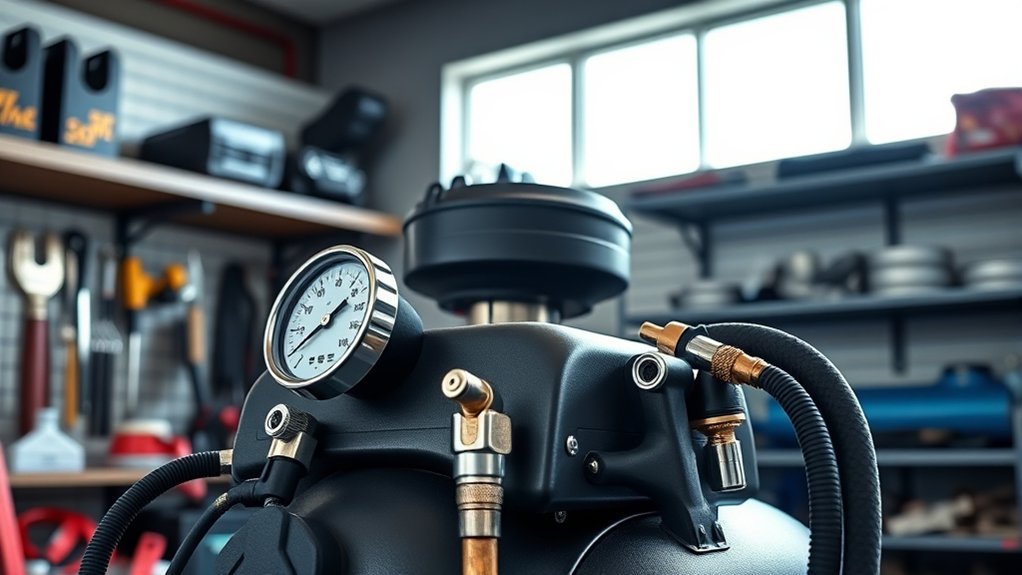
Understanding PSI and CFM is essential for selecting the right garage compressor, as these specifications directly impact performance and suitability for your tools. PSI (pounds per square inch) determines the pressure delivered, influencing air quality for specific applications. CFM (cubic feet per minute) indicates airflow volume, affecting the compressor’s ability to sustain operational demands. Accurate knowledge of these specs guarantees ideal tool performance and minimizes noise levels, which can be critical in a garage environment. Higher PSI and CFM ratings generally improve air quality for continuous use but may increase noise. Selecting a compressor with appropriate PSI and CFM ensures efficient operation, reduces unnecessary noise, and maintains air quality standards, enabling safe, effective, and quiet garage work.
What Garage Projects Require the Largest Air Compressors?
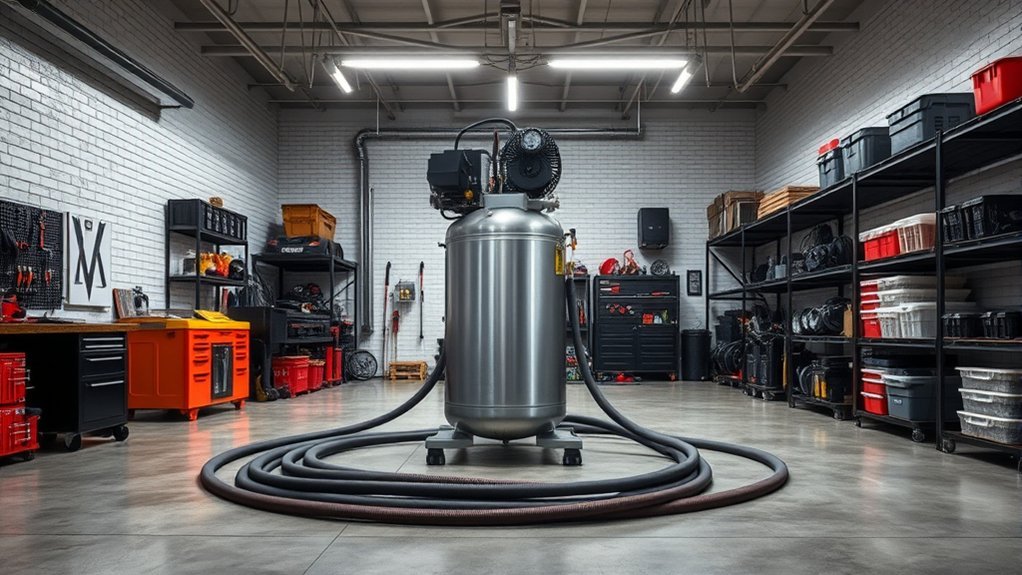
Garage projects that demand the largest air compressors typically involve tasks requiring sustained high airflow and pressure levels, such as pneumatic tool operation, paint spraying, or heavy-duty demolition. These projects necessitate compressors with high CFM ratings to guarantee consistent performance, especially for continuous use. Air quality becomes critical in applications like painting, where contaminants can compromise finish quality. Consequently, larger compressors often include filtration systems to maintain clean airflow. Noise levels are a significant consideration, as high-capacity units tend to generate substantial sound, potentially disrupting a workspace. Selecting a compressor that balances power with noise reduction features is vital to maintain a safe, efficient environment. These projects justify investing in robust, high-capacity equipment designed for ideal air quality and manageable noise output.
How to Choose the Right Compressor Size Based on Your Budget and Space
Selecting the appropriate compressor size requires evaluating available space and ensuring it fits within your garage dimensions. We also consider your budget constraints, balancing cost with necessary power and capacity. Finally, understanding your specific power needs and intended usage helps determine the ideal compressor size for your setup.
Space Constraints and Dimensions
When choosing an air compressor for your garage, evaluating available space is essential to guarantee proper functionality and safety. Adequate clearance ensures efficient ventilation systems and prevents overheating, especially in garages with limited space. Consider how garage insulation impacts airflow and temperature regulation, influencing compressor placement. Compressors should be positioned away from walls or insulation barriers to enhance ventilation and reduce noise transmission. Precise measurements of your garage’s dimensions help determine whether a vertical, horizontal, or tank-mounted unit best fits your layout. Ensuring sufficient clearance around the compressor also facilitates maintenance and reduces safety risks. Ultimately, understanding your garage’s size constraints enables selection of a compressor that optimizes performance while adhering to spatial limitations.
Budget-Friendly Options Available
Budget considerations considerably influence the size and type of air compressor you can choose for your garage. Opting for affordable models often means balancing compressor capacity with essential features like integrated air filters for cleaner output and noise reduction components to minimize sound levels. Smaller, piston-based compressors may be more cost-effective and suitable for light tasks, but they can generate higher noise levels. Conversely, mid-sized models often include built-in noise reduction technology, reducing operational disturbance.
| Budget Range | Compressor Type | Key Features | Considerations |
|---|---|---|---|
| Low | Piston, Portable | Basic air filter, minimal noise | Limited capacity, durability |
| Mid | Oil-lubricated, compact | Enhanced air filter, noise reduction | Better longevity, quieter |
| High | Rotary screw | Advanced filtration, silent operation | Higher cost, larger space |
Power Needs and Usage
Understanding your power needs and usage patterns is essential for choosing the appropriate compressor size, as mismatched capacity can lead to inefficiency or equipment failure. For tasks like paint spraying, which require consistent, high-volume airflow, a compressor with a higher CFM rating guarantees smooth operation and proper finish quality. Conversely, tire inflation demands lower airflow but still benefits from sufficient pressure, making a smaller compressor adequate. If you plan to use your garage compressor for multiple applications, consider a model with adjustable pressure settings and sufficient tank capacity to handle peak demands. Space constraints and power supply limitations also influence your choice, so balancing these factors with your intended usage will help optimize performance without exceeding your budget.
Portable vs. Stationary Compressors: Which Size Fits Your Garage Best?
When selecting between portable and stationary compressors, we consider factors like available space, power requirements, and intended usage. Portable units offer flexibility and compactness for light to moderate tasks, while stationary models provide higher performance for continuous, heavy-duty applications. Evaluating your garage’s space constraints, power needs, and operation frequency guides the ideal size and type choice.
Portability and Space Needs
Have you considered how your garage space and mobility needs influence the choice between portable and stationary air compressors? Portable models excel in flexibility, fitting into tight spaces and being easily moved. They come in various color options, allowing visual integration with your workspace. Stationary compressors require dedicated space, often occupying larger areas, but offer stability and higher capacity. Noise levels vary: portable units tend to be quieter, ideal for shared spaces, while stationary models can generate more sound. Use the table below to compare their space and portability features:
| Feature | Portable Compressor | Stationary Compressor |
|---|---|---|
| Space requirement | Compact, mobile | Large, fixed |
| Mobility | High | Low |
| Noise levels | Lower | Higher |
| Color options | Wide variety | Limited |
Choosing depends on your space constraints and mobility needs.
Power and Performance Levels
Choosing the appropriate compressor size depends heavily on the power and performance levels required for your garage tasks. For high-demand applications like spray painting or impact wrench use, a stationary compressor with higher PSI and CFM ratings is crucial, providing consistent airflow and power. Portable models typically offer lower PSI and CFM, suitable for light tasks, but may generate more air compressor noise during operation. Safety precautions are essential, especially with larger units, to prevent pressure hazards or overheating. Additionally, consider noise levels, as more powerful compressors tend to be louder; noise mitigation measures may be necessary to maintain a safe, comfortable environment. Matching your compressor’s power and performance capabilities to your specific needs ensures effective operation and safety in your garage workspace.
Usage Frequency and Duration
Evaluating your garage’s usage frequency and duration is essential in determining whether a portable or stationary air compressor best suits your needs. Frequent, prolonged use demands a stationary compressor, which generally offers higher CFM output, better oil lubrication, and consistent performance. Stationary units tend to operate with lower noise levels, but their size may be a drawback for limited spaces. Conversely, portable compressors are ideal for intermittent tasks, offering lower noise levels and ease of mobility. However, their smaller tanks and less robust oil lubrication systems may lead to quicker overheating and reduced efficiency during extended use. Understanding your typical usage duration helps balance these factors, ensuring you select a compressor that maintains ideal performance while minimizing noise disturbances and mechanical wear.
Common Mistakes When Selecting an Air Compressor Size for Your Garage
Selecting the wrong air compressor size often stems from a lack of understanding of your tools’ specific requirements, leading to operational inefficiencies and equipment damage. One common mistake is choosing a compressor with insufficient CFM or PSI, which hampers performance and strains the system. Overestimating size can result in unnecessary energy consumption, increased noise levels, and compromised air compressor safety. Additionally, neglecting noise reduction features can create a disruptive workspace, affecting safety and comfort. Proper sizing guarantees consistent airflow, minimizes wear, and maintains safe operation. It’s crucial to match compressor capacity to your tools’ demands while considering future expansion. Avoiding these mistakes promotes safer operation, reduces noise pollution, and enhances overall efficiency in your garage setup.
Tips for Installing and Maintaining Your Garage Air Compressor
Proper installation and regular maintenance are essential to guarantee your garage air compressor operates efficiently and safely. To assure air compressor safety, follow manufacturer guidelines for secure mounting, proper ventilation, and electrical connections. Establish a strict maintenance schedule that includes checking for leaks, draining moisture from tanks, inspecting hoses, and replacing filters as needed. Regularly lubricate moving parts to minimize wear and prevent breakdowns. Verify pressure regulation components are functioning correctly to avoid over-pressurization. Conduct routine safety checks such as testing emergency shutoffs and ensuring all safety valves are operational. Maintaining a disciplined maintenance schedule not only prolongs compressor lifespan but also guarantees safe operation, reducing the risk of accidents and assures consistent, high-quality performance in your garage environment.
Frequently Asked Questions
Can I Use a Smaller Compressor for Occasional Garage Tasks?
Yes, you can use a smaller compressor for occasional garage tasks; it enhances energy efficiency and noise reduction, making it suitable for light-duty work. Just make certain it provides adequate pressure and airflow for your specific tools.
How Loud Are Different Sizes of Garage Air Compressors?
They say “you get what you pay for,” and in noise levels, larger compressors typically produce higher decibel readings, often 80-90 dB, while smaller models stay quieter at around 70-75 dB, making them more suitable for noise-sensitive environments.
What Safety Features Should I Look for in a Garage Compressor?
We recommend safety precautions like guards and proper ventilation, and an emergency shutoff feature for immediate power cut in emergencies. These guarantee safe operation, prevent accidents, and comply with safety standards in garage compressor use.
How Often Should I Service or Replace Parts on My Compressor?
We recommend following the manufacturer’s maintenance schedule, typically inspecting and replacing parts like filters and valves every 3-6 months, depending on usage. Regular maintenance guarantees peak compressor performance and longevity, preventing costly breakdowns.
Is There a Recommended Brand or Model for Garage Air Compressors?
We recommend brands like California Air Tools and Makita for garage air compressors, ideal for paint spraying and tire inflation. Their models offer durability, quiet operation, and reliable performance, ensuring efficient, precise results for your projects.
Conclusion
Choosing the right size air compressor balances your project demands with space and budget constraints. While a compact model offers convenience, it may fall short for heavy-duty tasks. Conversely, larger compressors handle more demanding projects but require more space and investment. Precision in selecting the appropriate CFM and PSI guarantees efficiency and safety. Ultimately, understanding your specific needs allows us to optimize performance, avoiding the pitfalls of oversizing or undersizing, and ensuring longevity and reliability in our garage operations.