Ad Blocker Detected
Our website is made possible by displaying online advertisements to our visitors. Please consider supporting us by disabling your ad blocker.
When it comes to improving our business operations, choosing the right air compressor can make a significant difference. With so many options available, it’s essential to understand how different models can meet our specific needs for durability, performance, and efficiency. We’ve identified five top contenders that could help streamline tasks and reduce downtime. But what sets these models apart, and how do we determine the best fit for our business? Let’s explore further.
Key Takeaways
- Select compressors with sufficient capacity and airflow to meet high-demand tasks without downtime.
- Prioritize models with durability features and reliable components for long-term operational efficiency.
- Opt for portable designs with wheels and handles for easy movement across work sites.
- Choose quieter units with sound-dampening features to maintain a comfortable, safe work environment.
- Consider warranty and maintenance support to ensure consistent performance and lower operational costs.
DeWalt DXCMTB5590856 Honda Powered Wheelbarrow Compressor, 8 gallon
The DeWalt DXCMTB5590856 Honda Powered Wheelbarrow Compressor, with its 8-gallon tank and portable design, is ideal for professionals who need reliable, high-performance air power on-site. Equipped with a 160cc Honda GX160 engine, it offers robust airflow—11.6 CFM at 40 PSI and 9.9 CFM at 90 PSI—perfect for tasks like nailing, drilling, and spraying. Its twin-cylinder cast iron pump guarantees durability and quick recovery, while the wheelbarrow style with turf tread makes maneuvering across terrains effortless. With liquid-filled gauges and a ball drain valve, it provides precise control and easy maintenance, making it a versatile addition to any job site.
Best For: professionals and contractors requiring a portable, high-capacity air compressor for on-site tasks like nailing, drilling, and spraying.
Pros:
- Robust 160cc Honda GX160 engine ensures reliable and easy start operation.
- Twin-cylinder cast iron pump provides durability and quick recovery times.
- Portable wheelbarrow design with turf tread allows easy maneuverability across various terrains.
Cons:
- Weighs approximately 165 pounds, which may require assistance for transport.
- Noise level of around 80 decibels could be disruptive in noise-sensitive environments.
- The initial cost may be higher compared to smaller or electric compressors.
Industrial 3-Cylinder Silent Air Compressor, 5HP 60 Gal
Ideal for industrial environments demanding quiet, reliable operation, the Polar Air 5HP 60-Gallon Silent Air Compressor delivers consistent airflow while minimizing noise. Its vertical, ASME/CRN-certified tank holds 60 gallons and is paired with a durable 3-cylinder single-phase motor producing 19 CFM at 230V. The splash-lubricated cast iron pump is rated for 50,000 hours of continuous use, ensuring longevity. Operating at 1750 RPM, it runs cooler and quieter, thanks to Polar Air’s patented Silent Air technology, sound-canceling plates, and four-stage intake cleaning. Factory-installed isolator pads reduce vibration, making it ideal for demanding workshops and light manufacturing settings.
Best For: industrial workshops, garages, and light manufacturing facilities requiring reliable, quiet, and durable air compression.
Pros:
- Quiet operation due to patented Silent Air technology and sound-canceling features
- Durable splash-lubricated cast iron pump rated for 50,000 hours of use
- Space-efficient vertical tank design with vibration-reducing isolator pads
Cons:
- May be heavier and bulkier to move or install compared to smaller units
- Higher initial cost due to advanced noise reduction and build quality
- Requires regular maintenance of the cast iron pump for optimal performance
VEVOR 13-Gallon Oil-Free Air Compressor, 2HP
The VEVOR 13-Gallon Oil-Free Air Compressor delivers rapid airflow, making it perfect for both professionals and DIY enthusiasts. Its large 13-gallon tank and 2HP motor generate pressure in under three minutes, reaching up to 125 PSI with an airflow of 4.6 SCFM at 90 PSI. Built with durable steel and aluminum, it guarantees stability during demanding tasks like tire inflation, woodworking, or spray painting. Its oil-free, noise-reducing technology keeps operation quiet at 66dB. Portable with rubber wheels and a cylindrical design, it’s easy to move around. Plus, minimal maintenance and leak-proof valves make it a reliable, cost-effective choice for various applications.
Best For: DIY enthusiasts and professionals needing a portable, powerful air compressor for tasks like painting, auto repairs, and woodworking.
Pros:
- Rapid air buildup with a large 13-gallon tank and 2HP motor, ready in under 3 minutes
- Quiet operation at 66dB, making it suitable for indoor and noise-sensitive environments
- Durable construction with steel and aluminum, plus easy mobility thanks to rubber wheels
Cons:
- Weighs around 71 pounds, which may require effort to move frequently
- Requires a 120V power supply, limiting use in areas with different electrical standards
- Limited to a maximum of 125 PSI, which may not be suitable for very high-pressure applications
VEVOR 6.3 Gallon Oil-Free Air Compressor
With a powerful 1450W motor operating at 3500 rpm, the VEVOR 6.3 Gallon Oil-Free Air Compressor is perfect for professionals needing reliable, portable pneumatic tools. It delivers 3.35 CFM at 90 PSI with a max pressure of 116 PSI, supporting nail guns, impact wrenches, spray guns, and screwdrivers. Its durable, rust-resistant tank features a three-layer construction, ensuring safety and longevity. Quiet operation at around 70 decibels, combined with efficient cooling fans and overheating protection, makes it safe and easy to use. Compact and lightweight at 43 pounds, it’s ideal for auto repair, painting, and woodworking tasks on the go.
Best For: DIY enthusiasts and professionals who need a portable, reliable air compressor for auto repairs, painting, woodworking, and pneumatic tool operation.
Pros:
- Powerful 1450W motor with high CFM and PSI for efficient performance
- Durable, rust-resistant three-layer tank construction for safety and longevity
- Quiet operation at approximately 70 decibels, making it suitable for various work environments
Cons:
- Slightly heavy at 43 pounds, which may affect portability for some users
- Limited hose compatibility to 0.25-inch diameter hoses
- May require a dedicated power outlet due to its 120V operation and high power draw
DEWALT 60 Gallon Vertical Air Compressor, 3.7 HP
Looking for a reliable compressor that handles demanding workshop tasks? The DEWALT 60 Gallon Vertical Air Compressor, 3.7 HP, is perfect for both professionals and DIY enthusiasts. It offers a maximum of 155 PSI, with airflow rates of 13.4 SCFM at 40 PSI and 11.5 SCFM at 90 PSI, ensuring consistent power for high-demand jobs. Its vertical, space-saving design makes it easy to fit into tight workshops, while the durable, oil-lubricated pump guarantees long-term performance. Whether you’re working on heavy-duty projects or routine tasks, this compressor provides the capacity and reliability needed to boost your productivity efficiently.
Best For: DIY enthusiasts and professionals seeking a powerful, space-efficient air compressor for high-demand workshop and garage tasks.
Pros:
- High airflow rates of 13.4 SCFM at 40 PSI and 11.5 SCFM at 90 PSI for consistent performance
- Space-saving vertical design optimizes workshop space
- Durable, oil-lubricated pump ensures long-term reliability
Cons:
- Heavier and less portable due to its large 60-gallon tank
- Requires regular maintenance of oil-lubricated components
- May be overkill for light or occasional tasks, making it less cost-effective for casual use
Factors to Consider When Choosing Commercial Air Compressors
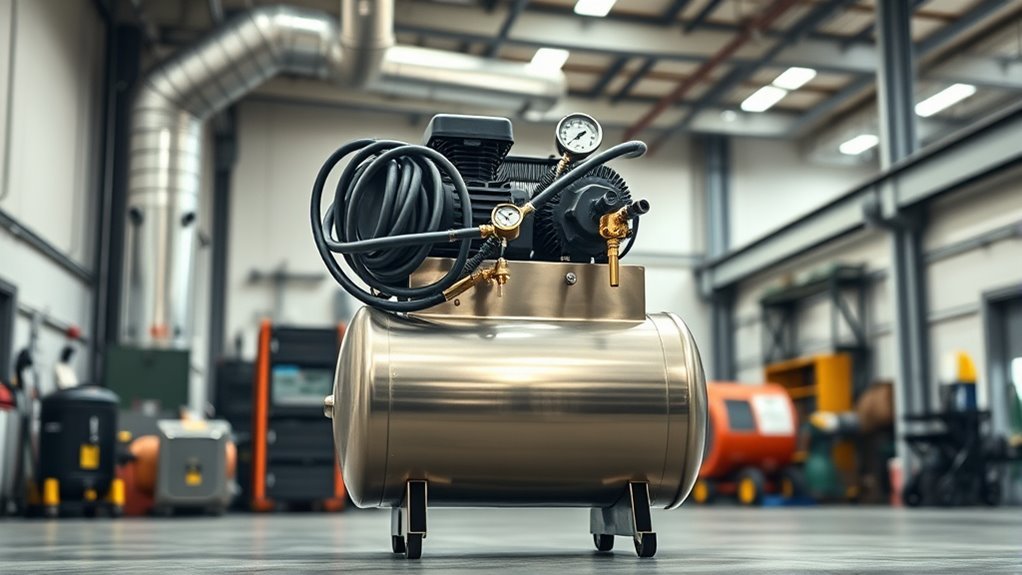
When selecting a commercial air compressor, we need to evaluate several key factors to guarantee it meets our specific needs. Consider the power and capacity to handle your workload, along with portability features if mobility is important. Additionally, paying attention to noise levels, durability, and maintenance requirements will help us choose a reliable and efficient unit.
Power and Capacity
How do we determine the right power and capacity for a commercial air compressor? First, we look at horsepower (HP). Higher HP units deliver more airflow and handle tougher tasks. Next, we consider capacity, usually indicated by tank size in gallons or liters, which determines how long the compressor can run before needing a refill. We also evaluate airflow rate—measured in CFM or SCFM—to ensure it matches the demands of your tools or applications. Additionally, the maximum pressure, in PSI, should meet your tools’ requirements without overloading the system. Balancing these factors—power, capacity, and airflow—ensures continuous operation, efficiency, and reliability. Getting this right helps us select a compressor that can handle your workload without frequent downtime.
Portability Features
Choosing the right commercial air compressor involves not only considering power and capacity but also how easily it can be moved around your worksite. Portability features like wheels, handles, and compact design make transportation straightforward, especially across different job sites. The compressor’s weight plays a big role—lighter units are easier to carry, while heavier models might need carts or dollies. Tank design also matters; options like twin wheelbarrow tanks or vertical cylinders can improve maneuverability and save space in tight areas. Built-in handles and foldable components help with quick setup and storage, saving time on the job. Additionally, noise reduction and vibration dampening features contribute to portability by allowing operation in more varied environments without disrupting nearby activities.
Noise Levels
Have you ever considered how noise levels from a compressor can affect your work environment? Noise is measured in decibels (dB), with quieter models producing around 60-70 dB, while louder units can exceed 80 dB. Lower noise levels are essential in settings like workshops or shared spaces, where minimal disruption boosts productivity. Many modern compressors feature sound-dampening elements, such as insulated enclosures, mufflers, or silencers, to keep noise to a minimum. Reduced noise not only improves worker comfort but also enhances safety, especially during long shifts or in enclosed areas. Investing in quieter models can lessen the reliance on hearing protection and create a more comfortable, efficient workspace, making noise level a critical factor in choosing the right compressor.
Durability Factors
When selecting a commercial air compressor, durability is a critical factor that directly impacts its performance and lifespan. We look for units built with high-quality materials like cast iron and steel, which can withstand continuous, heavy-duty use. Components such as pumps and tanks should be rated for extended operational hours, often over 50,000 hours. Design features like reinforced tanks and corrosion-resistant coatings help guarantee longevity in tough environments. Heavy-duty compressors also incorporate vibration-dampening systems and enclosed guards, protecting internal parts and reducing wear. Overall build quality and adherence to certification standards like ETL or CRN are reliable indicators of long-term durability. Prioritizing these factors helps us select equipment that offers consistent performance and minimizes downtime.
Maintenance Needs
Ever wondered what maintenance needs are essential for keeping commercial air compressors running smoothly? Regular tasks like checking and replacing oil, filters, and belts are critical for peak performance. Oil-lubricated compressors require more upkeep, including oil changes and level checks, compared to oil-free models. The frequency of maintenance depends on how much you use the compressor; heavy-duty operation might need weekly or monthly inspections. Proper maintenance extends the lifespan of key components such as the pump, valves, and gauges, helping to prevent costly breakdowns. Keeping detailed maintenance records ensures timely service and adherence to manufacturer recommendations. By staying on top of these tasks, we can maximize efficiency, reduce downtime, and ensure our compressors operate reliably for years to come.
Price and Warranty
Choosing the right commercial air compressor involves carefully weighing price and warranty options, as these factors considerably impact long-term value. Generally, a higher price reflects increased durability, greater airflow capacity, and longer warranty periods, which can save money over time. Warranty coverage varies from 30 days to several years, affecting the compressor’s overall cost-effectiveness. Extended warranties often include parts, labor, and maintenance, offering peace of mind for heavy-duty applications. On the other hand, budget models with shorter warranties may lead to more frequent repairs or replacements, raising operational costs. It’s essential to compare warranty terms to guarantee they align with your expected usage and maintenance needs, helping you make a smart investment that balances initial costs with long-term reliability.
Frequently Asked Questions
What Is the Average Lifespan of a Commercial Air Compressor?
We typically see commercial air compressors last between 10 to 15 years with proper maintenance. Regular servicing, quality components, and timely repairs can extend their lifespan, helping your business operate smoothly and efficiently over the years.
How Often Should Commercial Air Compressors Be Serviced?
We recommend servicing commercial air compressors every 3 to 6 months, depending on usage and environment. Regular maintenance guarantees peak performance, prevents breakdowns, and extends the lifespan, helping your business operate smoothly and efficiently.
What Are the Energy Efficiency Benefits of Oil-Free Compressors?
Oil-free compressors are like a revitalizing change, offering higher energy efficiency by eliminating the need for oil lubrication, reducing power consumption, and lowering operational costs, helping us save money while keeping our operations environmentally friendly.
Can Commercial Air Compressors Operate in Extreme Temperatures?
Yes, commercial air compressors can operate in extreme temperatures, but their efficiency depends on proper insulation and cooling systems. We guarantee these units are designed or adapted to withstand harsh conditions, maintaining consistent performance and minimizing downtime.
What Safety Precautions Are Essential When Using Large Air Compressors?
We always wear protective gear, guarantee proper ventilation, regularly inspect equipment, follow manufacturer guidelines, and keep clear of moving parts. These precautions help us operate large air compressors safely, preventing accidents and maintaining efficient, reliable performance.
Conclusion
Choosing the right air compressor is like finding a loyal partner—it keeps your business running smoothly and efficiently. With options ranging from compact, quiet units to heavy-duty tanks, we’re confident you’ll find the perfect fit. Remember, the right compressor isn’t just a tool; it’s the engine behind your success. Let’s power up your operations and turn potential into performance—because when your equipment runs seamlessly, so does your business.