Ad Blocker Detected
Our website is made possible by displaying online advertisements to our visitors. Please consider supporting us by disabling your ad blocker.
While many tools promise power, only a select few engine air compressors truly deliver versatility for any job. Whether tackling heavy-duty tasks or emergency roadside repairs, choosing the right model makes all the difference. But with so many options available, how do you know which compressor will perform reliably when it counts? Keep these top contenders in mind as we explore the features that set them apart and help you make an informed choice.
Key Takeaways
- Match compressor specifications like CFM, PSI, and horsepower to your tool and job requirements for optimal performance.
- Prioritize durable materials such as cast iron or steel for longevity and reliable operation under high pressure.
- Consider portability features like wheels, handles, and compact size for easy transport and workspace flexibility.
- Select models with application-specific features, such as OEM compatibility or adjustable pressure controls, for specialized tasks.
- Regular maintenance, including filter checks and lubrication, ensures consistent performance and extends compressor lifespan.
Unloader Pilot Check Valve & Throttle Cable for Compressors
If you’re looking to enhance the performance and reliability of your gas-powered air compressor, the Unloader Pilot Check Valve & Throttle Cable is an essential component, especially for those with 6.5HP units or smaller. This all-in-one device combines a pilot valve, check valve, and unloader valve, ensuring smooth operation and easier startup. It features a 36-inch adjustable throttle cable that relays engine signals effectively, along with manual toggles for quick control. Made of durable brass, it withstands outdoor environments and high pressures between 80 and 125 PSI. Installing this component improves efficiency, prevents pressure buildup, and makes your compressor more reliable.
Best For: those operating 6.5HP or smaller gas air compressors seeking a durable, integrated valve and throttle control solution for improved startup and efficiency.
Pros:
- Combines multiple functions (pilot, check, and unloader valves) into a single, all-in-one unit for convenience.
- Made from durable brass, suitable for outdoor and high-pressure environments.
- Adjustable throttle cable and manual toggles provide customizable control and ease of operation.
Cons:
- Designed specifically for compressors up to 6.5HP, limiting compatibility with larger units.
- Installation may require precise connection to existing systems; detailed instructions are necessary.
- The adjustable features and options may be overwhelming for users unfamiliar with compressor components.
Air Compressor Replacement for Cummins Engines
Choosing the right air compressor replacement for Cummins engines guarantees reliable performance and durability. The GELUOXI Air Compressor is specifically designed for Cummins models like K19, M11, N14, and C Series. It features OEM part numbers such as 211879, 213556, and others, confirming compatibility. Built from wear-resistant materials, it delivers stable airflow quickly and provides powerful output to keep tools running efficiently. With a robust construction, it’s made to withstand daily use. Plus, it comes with a 24-month warranty and supportive customer service. Just verify compatibility before buying to guarantee a perfect fit for your Cummins engine application.
Best For: professionals and technicians seeking a durable, high-performance air compressor replacement compatible with Cummins K19, M11, N14, and C Series engines.
Pros:
- Designed specifically for Cummins engine models ensuring a proper fit and reliable performance
- Constructed from wear-resistant materials for long-lasting durability
- Comes with a 24-month warranty and responsive customer support for peace of mind
Cons:
- Compatibility verification required before purchase to avoid mismatches
- May require professional installation due to technical specifications
- Availability might be limited in certain regions or stores
Portable Car Jump Starter with Air Compressor
A portable car jump starter with an air compressor is ideal for drivers who need a reliable, all-in-one tool for emergencies and on-the-go inflation needs. With a peak current of 3000A, it can jump-start engines up to 12L gas and 10L diesel, even in extreme temperatures. Its powerful compressor supports four inflation modes—car, motorcycle, bicycle, and basketball—and delivers up to 150 PSI. The device also features a LED flashlight, a 12,000mAh power bank, and an easy-to-read LCD display. Compact and lightweight, it’s perfect for keeping in your vehicle for quick fixes, roadside emergencies, or outdoor adventures.
Best For: drivers and outdoor enthusiasts who need a reliable, all-in-one emergency tool for vehicle jump-starting, tire inflation, and portable charging on the go.
Pros:
- Combines multiple functions (jump starter, air compressor, power bank) into a compact device, saving space and weight.
- Capable of jump-starting large engines up to 12L gas and 10L diesel in extreme temperatures, ensuring reliability in various conditions.
- Easy-to-read LCD display and multiple inflation modes with high-pressure capacity for versatile roadside and outdoor use.
Cons:
- The device’s small size may limit its power capacity for continuous or heavy-duty use over extended periods.
- Requires careful handling of the air compressor nozzles and pressure settings to avoid over-inflation or damage.
- Limited color options and basic design may not appeal to users seeking a more premium or rugged appearance.
DeWalt 4-Gallon Gas-Powered Portable Air Compressor
The DeWalt 4-Gallon Gas-Powered Portable Air Compressor stands out for its Honda GX160 163cc gas engine, making it ideal for professionals needing reliable, portable power. Its precision camshaft design guarantees efficient valve timing and fuel use, while delivering 6.9 SCFM at 40 psi and 5.0 SCFM at 90 psi, suitable for various pneumatic tools. The oil-free, direct drive pump minimizes maintenance and enhances durability. With a 1/4-inch regulator, pressure gauges, and quick coupler, it offers easy setup. Its portable build makes it perfect for rooftops, construction sites, or frameworks, delivering powerful, on-the-go performance wherever you need it.
Best For: professionals and contractors seeking a reliable, portable air compressor for on-site pneumatic tool use across rooftops, frameworks, and construction sites.
Pros:
- Powerful Honda GX160 engine delivers consistent performance and fuel efficiency.
- Portable design easily transports to various job sites and work environments.
- Low-maintenance, oil-free pump reduces upkeep and ensures durability.
Cons:
- 4-gallon tank may require frequent refilling during extended use.
- Heavier and bulkier compared to electric or smaller portable compressors.
- Noise level from gas engine could be disruptive in quiet or enclosed workspaces.
Vevor 7.5HP Air Compressor Motor, 230V
Ideal for demanding air compression tasks, the Vevor 7.5HP Motor delivers reliable power with its robust 230V design and high-performance specs. It operates at 3450 RPM, providing the torque needed for heavy-duty applications. The motor features a durable steel frame and an open drip-proof design, suitable for clean, dry environments. Its reversible rotation adds installation flexibility, while the 1-1/8″ keyed shaft ensures secure coupling. Certified by CSA, this motor is built for long-term use, supporting full load operation at 31.6 amps. Whether powering large compressors or industrial setups, it offers dependable performance and durability.
Best For: professionals and industrial users requiring reliable, high-power air compressor motors for demanding applications.
Pros:
- High-performance 7.5HP motor suitable for heavy-duty tasks
- Reversible rotation offers installation flexibility
- Durable steel construction ensures long service life
Cons:
- Requires a 60-amp circuit breaker, which may necessitate additional electrical setup
- Open drip-proof design may limit use in dusty or harsh environments
- Hefty size and weight could pose handling and installation challenges
Factors to Consider When Choosing Engine Air Compressors
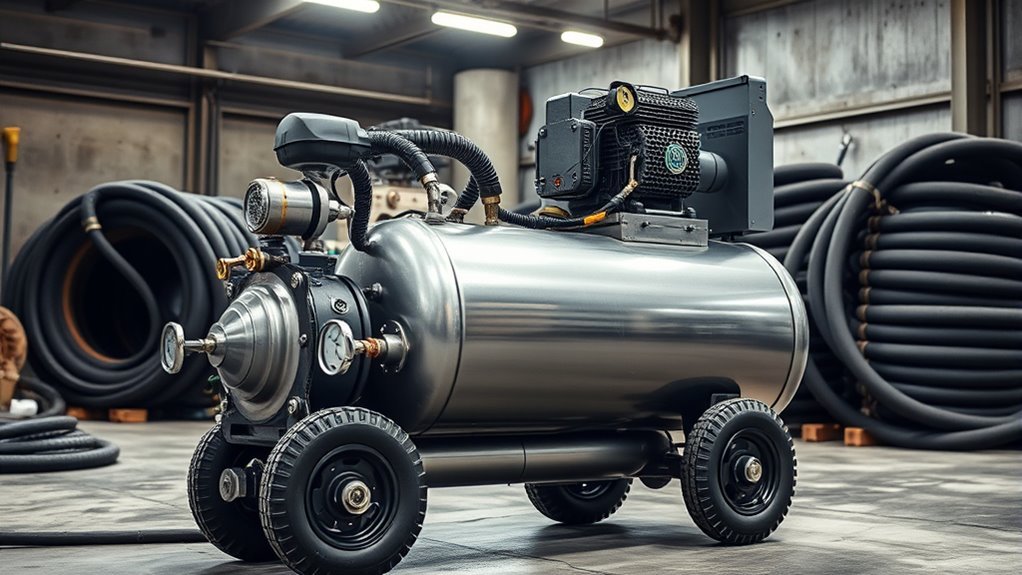
When selecting an engine air compressor, we need to think about the power and capacity to match our projects. It’s also important to take into account compatibility with existing tools, as well as durability, portability, and maintenance requirements. By focusing on these key factors, we can find the best compressor for our needs.
Power and Capacity
Choosing the right engine air compressor hinges on understanding its power and capacity. Power, usually measured in horsepower (HP), determines how much airflow and pressure the compressor can deliver—higher HP models handle tougher jobs. Capacity, indicated by flow rate in cubic feet per minute (CFM), shows how much air the compressor supplies at a given pressure. It’s crucial to match these specs with your tools’ requirements. Also, verify the compressor’s PSI rating meets the pressure demands of your applications. The motor size, like 7.5 HP or 6.5 HP, directly impacts overall capacity and efficiency. Selecting a compressor with appropriate maximum pressure and airflow ratings ensures it can handle your workload, providing reliable performance and longevity without overworking the system.
Compatibility Requirements
Have you checked whether your engine air compressor is compatible with your existing setup? Confirming compatibility means matching the compressor’s horsepower and voltage to your engine’s specifications, so performance remains smooth and reliable. Also, verify the inlet and outlet connection sizes, like 1/2″ NPT, to ensure proper fitting with your piping and hoses. It’s important to confirm the maximum operating pressure, such as 125 PSI, aligns with your tool requirements. Additionally, check the flow rate, measured in CFM, to match your airflow demands. Ultimately, consider the compressor’s physical dimensions and mounting options, making sure it fits comfortably within your available space. Taking these factors into account helps prevent performance issues and ensures your compressor integrates seamlessly into your setup.
Durability and Materials
Durability and the materials used in an engine air compressor directly impact its longevity and performance. High-quality materials like cast iron, steel, and brass are essential for withstanding wear and environmental conditions. All-brass components, such as valves, resist corrosion and guarantee long-lasting operation, especially outdoors or in humid settings. Using wear-resistant materials for critical parts like pistons and cylinders boosts the compressor’s lifespan and reliability during continuous use. Steel frames and open drip-proof designs help dissipate heat efficiently, reducing thermal damage risks. Choosing a compressor with robust construction assures it can handle high pressures, up to 150 PSI, and temperature ranges from -65°F to 400°F without degrading. These durable materials guarantee consistent performance and durability over time.
Portability and Size
Portability and size are crucial factors when selecting an engine air compressor, especially for those who need flexibility in where and how they work. Smaller, portable compressors are lightweight and easy to carry, making them perfect for on-the-go tasks or remote job sites. Many feature integrated handles or wheels, simplifying transportation and storage. Larger, stationary models are bulkier and designed for fixed setups in workshops or industrial environments. The size of the compressor also influences its airflow capacity; smaller units tend to have lower CFM ratings, suitable for light-duty tasks. When choosing a portable compressor, it’s important to take into account its dimensions and weight to ensure it fits comfortably within your workspace and transportation needs.
Maintenance Needs
When selecting an engine air compressor, considering its maintenance needs is vital to guarantee it operates smoothly and lasts longer. Regularly checking and replacing air filters ensures maximum airflow and prevents dirt buildup that can damage the system. Lubricating moving parts like bearings and pistons reduces wear and extends the compressor’s lifespan. Monitoring oil levels and quality, especially in oil-lubricated models, helps prevent overheating and mechanical failures. It’s also important to inspect and clean the cooling system regularly to maintain proper operating temperatures. Additionally, routine checks of hoses, fittings, and valves for leaks or damage keep the compressor running efficiently and safely. Prioritizing these maintenance tasks helps avoid costly repairs and ensures reliable performance on every job.
Frequently Asked Questions
How Do I Maintain Optimal Performance of My Engine Air Compressor?
We keep our engine air compressors in top shape by regularly checking and changing the oil, inspecting hoses for leaks, cleaning or replacing air filters, and following the manufacturer’s maintenance schedule to guarantee peak performance on every job.
What Safety Precautions Should I Follow When Using an Air Compressor?
Think of using an air compressor like handling a loaded gun; always wear safety gear, check for leaks, and keep bystanders clear. We follow these precautions carefully, ensuring safe, efficient operation every time we power up.
How Do I Troubleshoot Common Air Compressor Issues?
When troubleshooting air compressor issues, we check for leaks, guarantee proper oil levels, clean or replace filters, verify pressure settings, and inspect belts and hoses. Regular maintenance and safety checks help prevent most common problems.
What Is the Typical Lifespan of an Engine Air Compressor?
Typically, engine air compressors last around 10 to 15 years with proper maintenance. We recommend regular inspections, oil changes, and cleaning to extend their lifespan, ensuring reliable performance for all your demanding jobs.
Can Engine Air Compressors Be Used for Industrial-Scale Projects?
Like a trusty steed in a grand race, our engine air compressors can handle industrial-scale projects. They’re built tough, reliable, and powerful enough to meet large demands, making them ideal for heavy-duty, large-scale tasks.
Conclusion
Choosing the right engine air compressor is like finding the perfect gear to keep your projects rolling smoothly. With options that boast durability, power, and portability, we’re confident you’ll find one that fits your needs like a glove. Remember, regular maintenance keeps these reliable machines humming along just like a well-oiled engine. So, gear up and pick the compressor that’ll be your trusty sidekick, ready to tackle any job that comes your way.