Ad Blocker Detected
Our website is made possible by displaying online advertisements to our visitors. Please consider supporting us by disabling your ad blocker.
When we think about running a mechanic shop efficiently, having the right air compressor can make all the difference. For instance, a heavy-duty rotary screw compressor keeps up with continuous tasks, but quieter, oil-free models are perfect for noise-sensitive environments. Choosing the best options can seem overwhelming, especially with so many features to evaluate. Let’s explore the seven best air compressors that every mechanic shop should have—because knowing what works best can truly streamline your work.
Key Takeaways
- Prioritize high CFM and PSI ratings for powering pneumatic tools and heavy-duty tasks efficiently.
- Choose durable, industrial-grade compressors with reliable performance and long lifespan for shop use.
- Opt for quiet models to maintain a comfortable, noise-sensitive work environment.
- Consider portability features like wheels and compact design for flexible shop setup and mobility.
- Ensure compliance with safety standards and easy maintenance to keep operations safe and minimize downtime.
10HP Rotary Screw Air Compressor with Dryer & Tank
The 10HP Rotary Screw Air Compressor with Dryer & Tank is an ideal choice for mechanic shops that demand reliable, high-capacity compressed air. Its industrial-grade design features a powerful 230V 3-phase motor protected by IP54, along with a fully enclosed dust-proof casing and Class F insulation. The 66-gallon ASME-certified tank offers an air flow of 32 CFM and a maximum pressure of 145 PSI, ensuring consistent performance. Equipped with a durable rotary screw, advanced oil separation, and intelligent control system, it provides automatic operation, energy efficiency, and easy remote monitoring—perfect for demanding industrial environments.
Best For: mechanic shops and industrial environments that require reliable, high-capacity compressed air with automatic operation and energy efficiency.
Pros:
- Industrial-grade construction with durable components for long-term use
- Advanced oil separation system ensures low oil carryover in discharged air
- Intelligent control system allows for automatic operation and remote monitoring
Cons:
- May require professional installation due to its size and electrical requirements
- Initial cost could be higher compared to smaller or less advanced compressors
- Heavyweight and large tank size might limit portability and space in smaller workshops
Vevor 50ft Retractable Air Hose Reel with Swivel
If you’re looking for versatile installation and easy mobility, the Vevor 50ft Retractable Air Hose Reel with Swivel is an excellent choice. Its ceiling or wall mount design features a 180° swivel, making positioning flexible for any workspace. The sturdy steel reel and weather-resistant polypropylene construction guarantee durability, while the portable handle allows quick relocation. The 50-foot hybrid polymer hose, rated for 300 PSI, provides smooth retraction and extension with minimal wear. Easy to install with included hardware, it’s perfect for auto shops, garages, or mobile setups. Its user-friendly auto-rewind mechanism and locking stopper make operation simple and efficient.
Best For: DIY enthusiasts, auto shop professionals, and mobile mechanics seeking a durable, flexible, and easy-to-mount air hose solution for versatile workspace setups.
Pros:
- Durable steel reel with weather-resistant polypropylene construction for long-term use
- 180° swivel mounting allows flexible positioning on ceilings, walls, or floors
- Smooth auto-rewind mechanism with locking stopper for easy operation and hose management
Cons:
- Heavier weight (around 13 pounds), which may require additional support during installation
- Limited to 50 feet length, which might not suit very large or expansive workspaces
- Requires proper mounting hardware and setup to ensure stability and safety
California Air Tools 4.0 HP Oil-Free Air Compressor
For busy mechanic shops prioritizing quiet operation, the California Air Tools 4.0 HP Oil-Free Air Compressor is an excellent choice. Operating at just 75 decibels, it stays quiet while delivering impressive airflow—12.80 CFM at 40 PSI and 10.60 CFM at 90 PSI. Its twin 2.0 HP motors run smoothly at 1680 RPM, reducing noise and wear. The oil-free dual piston pump offers over 3,000 hours of lifespan and cleaner air with less maintenance. With a large 60-gallon steel tank and built-in automatic drain valve, it handles demanding tasks efficiently and conveniently in any shop environment.
Best For: busy mechanic shops and professionals seeking a quiet, reliable, and high-capacity air compressor for demanding tasks.
Pros:
- Operates at only 75 decibels, making it one of the quietest options available.
- Features twin 2.0 HP motors that reduce noise, wear, and enhance durability.
- Oil-free dual piston pump provides over 3,000 hours of lifespan and cleaner air with less maintenance.
Cons:
- The large dimensions (21″ x 28.5″ x 66″) may require significant space for setup.
- The 60-gallon tank, while large, may be heavy and challenging to move or reposition.
- Higher initial cost compared to smaller or less feature-rich compressors.
Ultra Quiet Air Compressor with Steel Tank
Looking for a quiet, reliable air compressor that won’t disrupt your workspace? The Limodot LJ2100 is an excellent choice. It’s portable, with a durable 2-gallon steel tank, and operates at just 60dB, making it ideal for noise-sensitive environments. Powered by a 1HP motor, it delivers up to 120 PSI and 2.5 CFM at 90 PSI, ensuring quick recovery times of around 14 seconds. Its oil-free design means less maintenance and better cold-weather performance. Lightweight at 35 pounds and featuring a quick connect coupler, it’s perfect for various tasks like tire inflation, spray painting, and pneumatic tools, whether in a garage or workshop.
Best For: DIY enthusiasts, automotive repair professionals, and workshop users seeking a quiet, portable, and reliable air compressor for various pneumatic tasks.
Pros:
- Ultra quiet operation at only 60dB, ideal for noise-sensitive environments
- Compact and lightweight design for easy portability and space-saving setup
- Oil-free motor reduces maintenance and performs well in cold weather
Cons:
- Limited 2-gallon tank size may require longer downtime for larger continuous tasks
- Maximum pressure of 120 PSI might not suffice for heavy-duty industrial applications
- May be less suitable for high-demand commercial use due to its smaller capacity
8-Gallon Ultra Quiet Oil-Free Air Compressor
The 8-Gallon Ultra Quiet Oil-Free Air Compressor is ideal for shops needing reliable, low-noise performance. Its lightweight, portable design with a handle and wheels makes it easy to move around. Powered by a 1.5HP oil-free motor, it delivers 4.52 CFM at 115 PSI and quickly fills the tank within 90 seconds. Operating at a maximum of 70dB, thanks to dual silencers, it’s perfect for noise-sensitive environments. Built with durable, anti-rust materials, it features safety protections like overheating prevention and auto shut-off. Its sturdy construction and efficient performance make it a versatile, dependable choice for any mechanic shop.
Best For: professionals and hobbyists in workshops or garages requiring a quiet, portable, and reliable air compressor for various pneumatic tasks.
Pros:
- Lightweight and portable with handle and wheels for easy movement
- Operates quietly at a maximum of 70dB, ideal for noise-sensitive environments
- Quick fill time, reaching maximum pressure within 90 seconds
Cons:
- Limited to 8-gallon tank capacity, which may require frequent refilling for larger projects
- May not be suitable for heavy-duty industrial applications requiring higher pressure or volume
- The oil-free design might necessitate more frequent maintenance or part replacements over time
VEVOR 13-Gallon 2HP Air Compressor, Oil-Free, Quiet
The VEVOR 13-Gallon 2HP Air Compressor is ideal for shops needing quiet, efficient operation, thanks to its noise level of just 66dB. It features a large 13-gallon tank and a 2HP motor that delivers rapid air buildup in under three minutes, making it perfect for tasks like tire inflation, woodworking, auto repairs, and spray painting. Built with durable steel and aluminum components, it offers stability and longevity. Its oil-free, noise-reducing technology minimizes maintenance and operational costs. With portability in mind, it has rubber wheels and a compact design, allowing easy movement around the shop.
Best For: DIY enthusiasts, professional mechanics, and woodworking shops seeking a quiet, durable, and portable air compressor for various tasks.
Pros:
- Quiet operation at only 66dB, ideal for noise-sensitive environments
- Rapid air buildup in under 3 minutes with a large 13-gallon tank
- Durable construction with steel and aluminum components for long-term use
Cons:
- Weighs around 71 pounds, which may require effort to move frequently despite the wheels
- Limited to 120V power supply, restricting use in some international locations
- No included accessories or tools, requiring additional purchases for specific applications
30 Gal Gas Air Compressor, 13HP, 24CFM, 180psi
A 30-gallon gas air compressor with 13HP and 24 CFM is ideal for heavy-duty mechanic shops demanding reliable, high-capacity airflow. Its two-stage compression system delivers up to 180 psi, making it suitable for demanding tasks like cutting, grinding, and sandblasting. Powered by a durable 420cc gas engine with electric start, it’s designed for mobility and tough environments. The cast iron construction guarantees longevity, while safety features like pressure gauges and relief valves add security. With a large tank and robust build, this compressor offers consistent performance for extended use across automotive, industrial, and agricultural applications.
Best For: heavy-duty automotive, industrial, and agricultural professionals needing reliable, high-capacity compressed air for demanding tasks.
Pros:
- Powerful 13 HP gas engine with two-stage compression delivers up to 180 psi and 24 CFM airflow.
- Durable cast iron construction ensures longevity and easy maintenance.
- Mobile design with compatibility for truck beds and service vehicles, ideal for on-the-go use.
Cons:
- Heavy weight of 432 pounds may require assistance for transportation and setup.
- Large size (approximately 47 x 21 x 46 inches) may limit storage options in smaller spaces.
- Gas-powered operation requires regular fueling and maintenance, which may be less convenient than electric models.
Factors to Consider When Choosing Air Compressors for a Mechanic Shop
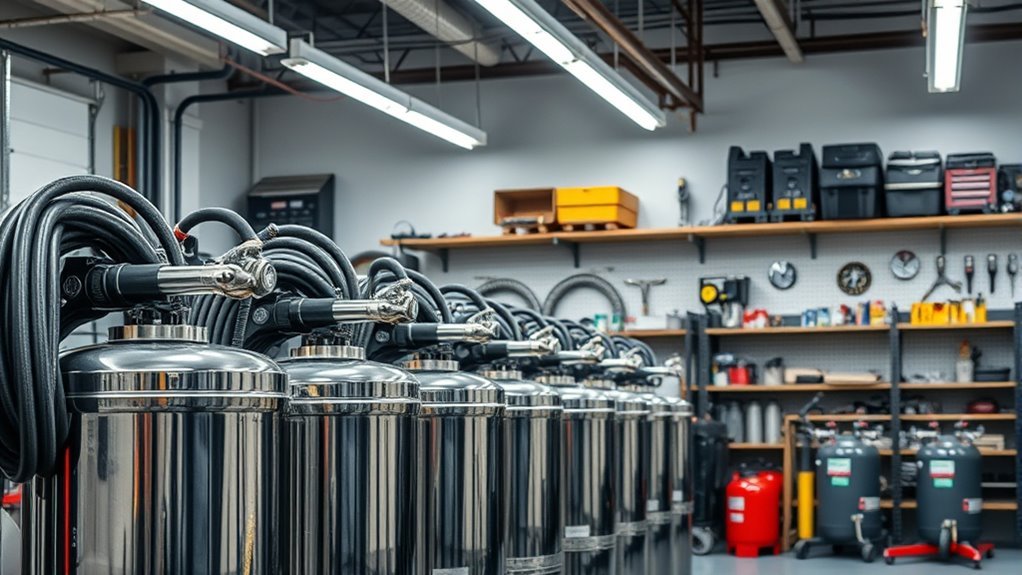
When selecting air compressors for our shop, we need to evaluate several key factors to ensure we meet our needs effectively. We should assess airflow requirements, power needs, noise levels, portability, and how easy it is to maintain the unit. Addressing these points helps us choose the best compressor for our specific work environment.
Airflow Needs
Determining the right airflow capacity is essential for selecting an air compressor that meets your shop’s needs. The airflow, measured in CFM, indicates how much air your tools require to operate efficiently. If you run multiple pneumatic tools simultaneously, higher CFM ratings become crucial to maintain performance without delays. It’s important to match the compressor’s CFM output at your shop’s typical operating pressure to the demands of your most air-intensive tools. Underestimating airflow needs can cause tools to perform poorly and slow down work, while overestimating can lead to unnecessary costs and higher energy consumption. Properly evaluating your shop’s airflow requirements ensures smooth operation, prevents malfunctions, and boosts overall productivity. This approach helps you choose an air compressor that’s both efficient and reliable for daily use.
Power Requirements
Choosing the right air compressor for your shop hinges on understanding its power requirements. First, verify the compressor’s horsepower (HP) aligns with your tools and workload, as higher HP units typically deliver more airflow. Check the voltage and phase needs—such as 230V 3-phase—to confirm compatibility with your electrical system. Consider the maximum PSI to meet the pressure demands of your pneumatic tools, preventing underperformance. Match the compressor’s airflow capacity (CFM) at specific PSI levels to your operational needs, ensuring tools run efficiently. Keep in mind that larger, more powerful compressors usually consume more energy, which can increase operational costs. Balancing power, efficiency, and cost is essential to choosing a compressor that supports your shop’s productivity.
Noise Levels
Have you ever considered how noise levels from air compressors impact your shop environment? Lower noise levels are vital for maintaining a comfortable and safe workspace. Compressors operating at 60dB or less are considered ultra-quiet, making them perfect for noise-sensitive settings. Prolonged exposure to noise above 85dB can cause hearing damage, so quieter models are better for extended use. Oil-free compressors tend to operate more quietly because they generate less internal friction. To make sure you choose the right model, it’s important to measure and compare decibel ratings carefully. Selecting a compressor with a suitable noise level helps create a safer, more pleasant work environment, reducing fatigue and the risk of hearing issues for everyone in the shop.
Portability Features
Portability is a crucial factor when selecting an air compressor for a mechanic shop, especially since mobility can considerably improve workflow efficiency. Portable compressors often feature wheels, handles, or compact designs that make moving them around straightforward. Integrated or detachable wheels allow quick repositioning, which is essential during busy workdays. Lightweight materials like aluminum or reinforced steel help reduce weight, easing transportation and setup. Foldable or collapsible parts can also save space when storing the compressor when not in use. Additionally, quick-connect fittings and ergonomic handles enhance handling and maneuverability. These features guarantee that moving and repositioning the compressor doesn’t slow down work, allowing our team to stay productive and flexible throughout the day.
Maintenance Ease
When selecting an air compressor for a mechanic shop, making maintenance straightforward can save us significant time and effort. Oil-free pumps are a great choice because they eliminate the need for oil changes and related servicing, reducing downtime. Compressors with accessible service panels and clearly labeled parts make routine inspections and repairs faster and easier. Automatic drain valves help prevent moisture buildup, extending the lifespan of components and cutting manual maintenance. Choosing units with durable, corrosion-resistant materials minimizes repairs and part replacements over time. Additionally, easy-to-replace filters improve operational efficiency and reduce shop downtime. Overall, selecting a compressor designed with maintenance in mind ensures smoother operations, less hassle, and increased reliability for our shop.
Safety Standards
Choosing an air compressor for a mechanic shop means prioritizing safety standards that protect both personnel and equipment. We look for models that comply with industry safety standards like OSHA regulations and ASME certification for pressure vessels. Essential safety features include automatic shut-off, pressure relief valves, and thermal overload protection, which help prevent accidents. Clear labeling of maximum pressure and operational limits ensures safe usage and helps avoid overloads. Regular maintenance and inspections are crucial to identify potential hazards such as leaks or worn components before they become serious issues. Additionally, we consider noise levels, opting for compressors that stay below 85 dB to reduce hearing damage risks during prolonged use. Prioritizing these safety standards ensures a safer, more reliable working environment.
Frequently Asked Questions
What Maintenance Is Required for Different Types of Air Compressors?
We regularly check and change oil, clean or replace filters, drain moisture from tanks, inspect hoses for wear, and guarantee belts are tight. Proper maintenance keeps compressors running smoothly and extends their lifespan.
How Do I Determine the Right CFM for My Shop Tools?
Think of CFM as the heartbeat of your tools; we measure it to match their needs. We determine the right CFM by adding up each tool’s requirements and choosing a compressor that comfortably meets or exceeds that total.
What Safety Precautions Should Be Taken With High-Pressure Compressors?
We recommend always wearing safety goggles and hearing protection, inspecting hoses regularly, avoiding over-pressurization, and ensuring all safety valves are functional. Keep clear of moving parts, and follow the manufacturer’s guidelines closely for safe operation.
How Often Should Air Filters and Dryers Be Serviced or Replaced?
We recommend servicing or replacing air filters and dryers every 6 to 12 months, depending on usage and environment. Regular maintenance guarantees peak performance, prevents moisture buildup, and prolongs the lifespan of your compressor system.
Can Portable Compressors Handle Continuous Heavy-Duty Shop Operations?
Portable compressors generally struggle with continuous heavy-duty shop operations because their design prioritizes mobility over sustained power. For demanding tasks, we recommend stationary units, which offer the durability and capacity needed for nonstop industrial or workshop use.
Conclusion
Choosing the right air compressor can transform your shop’s efficiency. Imagine completing a tire replacement or brake job faster, thanks to a reliable, high-performance unit. For example, a small shop upgraded to a rotary screw compressor and saw a noticeable boost in productivity and customer satisfaction. Investing in the right equipment isn’t just about tools—it’s about empowering your team to work smarter, faster, and with less stress. Let’s select the perfect compressor to elevate your shop’s success.