Ad Blocker Detected
Our website is made possible by displaying online advertisements to our visitors. Please consider supporting us by disabling your ad blocker.
As auto shop owners, we consider the importance of having reliable air compressors tailored to different tasks. From portable pancake models to high-capacity units, selecting the right equipment can make a significant difference in our daily operations. With so many options available, knowing which compressors suit various needs is essential for efficiency, safety, and cost-effectiveness. Let’s explore the top five models that can help us keep our shops running smoothly—there’s more to consider than you might expect.
Key Takeaways
- Choose compressors with sufficient CFM and PSI to support multiple auto tools simultaneously for efficiency.
- Prioritize quiet, oil-free models for a comfortable, low-maintenance shop environment.
- Consider portable pancake compressors for limited space and lightweight tasks.
- Invest in durable, high-capacity units like 60-gallon tanks for heavy-duty, continuous use.
- Ensure safety features and proper airflow compatibility to enhance performance and operator safety.
ECOMAX 6-Gallon 150 PSI Pancake Air Compressor
The ECOMAX 6-Gallon 150 PSI Pancake Air Compressor is an excellent choice for both DIY enthusiasts and professionals who need a portable, reliable compressor for various tasks. Its compact, pancake-style design makes it easy to transport, and the flip-up handle adds convenience. Powered by a 1.5 HP motor, it supports low-voltage and cold-weather starts, making it versatile for different environments. With a 6-gallon tank and a maximum PSI of 150, it provides steady airflow for inflating tires, operating spray guns, or carving machines. Its oil-free pump reduces maintenance needs, ensuring long-lasting performance for both household and professional use.
Best For: DIY enthusiasts and professionals seeking a portable, reliable air compressor for a variety of tasks including inflating, spray painting, and carving.
Pros:
- Compact, pancake-style design with a flip-up handle for easy portability and storage
- Oil-free pump reduces maintenance and ensures long-lasting performance
- Supports low-voltage and cold-weather starting, increasing versatility in different environments
Cons:
- Noise level of approximately 75 decibels may be loud for some users
- Limited tank capacity of 6 gallons may require additional downtime for larger projects
- Maximum PSI of 150 might be insufficient for heavy-duty industrial applications
Metabo HPT 6-Gallon Portable Pancake Air Compressor
For professionals seeking reliable power, the Metabo HPT 6-Gallon Portable Pancake Air Compressor delivers impressive performance with its 200 PSI capacity, offering 25% more pressure than standard models. Its 4 CFM airflow at 90 PSI allows multiple large nailers to run simultaneously, keeping productivity high. Designed for versatility, it can operate two framing or roofing nailers, three finish nailers, or five brad nailers at once, ensuring minimal delay. Weighing only 41 lbs, it’s 22% lighter than traditional twin-stacks, making it easy to transport around job sites. Backed by Metabo HPT’s reputation and a 1-year warranty, it’s a dependable, professional-grade choice.
Best For: professional contractors and serious DIYers who need a reliable, portable air compressor capable of handling multiple pneumatic tools simultaneously.
Pros:
- Delivers 200 PSI for increased power and performance
- Supports multiple nailers at once, enhancing productivity
- Lightweight at 41 lbs, making it easy to transport on job sites
Cons:
- Limited to 6-gallon capacity, which may require frequent refills during extended use
- May be more expensive than basic pancake compressors for casual users
- Does not include additional attachments or accessories, requiring separate purchase
California Air Tools CAT-60040CAD 4.0 HP Air Compressor
Ideal for noise-sensitive environments, the California Air Tools CAT-60040CAD operates at just 75 decibels, ensuring quiet yet powerful performance. It delivers an airflow of 12.80 CFM at 40 PSI and 10.60 CFM at 90 PSI, making it highly efficient. Equipped with twin 2.0 HP motors running at 1680 RPM, it reduces noise and wear while providing increased duty cycle for continuous operation. Its oil-free dual piston pump offers over 3,000 hours of lifespan, ensuring cleaner air and less maintenance. With a large 60-gallon steel tank and automatic drain valve, it’s perfect for demanding tasks in a shop or garage setting.
Best For: individuals or professionals working in noise-sensitive environments who need a powerful, reliable, and low-maintenance air compressor for demanding tasks.
Pros:
- Operates at just 75 decibels, making it one of the quietest compressors suitable for noise-sensitive areas
- High airflow capacity of 12.80 CFM at 40 PSI and 10.60 CFM at 90 PSI for efficient performance
- Oil-free dual piston pump with over 3,000 hours of lifespan reduces maintenance and ensures cleaner air
Cons:
- Large size (66 inches in height) may require ample space for installation
- Higher initial cost compared to smaller or less feature-rich compressors
- Heavy weight due to the large steel tank (60 gallons) may make portability difficult
Vevor 2-Gallon Oil-Free Portable Air Compressor
If you’re seeking a portable compressor that combines power and ease of maintenance, the Vevor 2-Gallon Oil-Free Portable Air Compressor fits the bill perfectly. It features a 2-gallon steel tank, a 1 HP oil-free motor, and delivers 2.1 CFM at 90 PSI, with a maximum pressure of 120 PSI. Its oil-free design makes it low-maintenance, while its rust-resistant construction ensures durability. Operating quietly at around 81 dB, it’s equipped with safety features like automatic shut-off and overheating protection. This compressor is versatile, suitable for pneumatic tools, tire inflation, spray painting, and woodworking, making it an ideal addition to any auto shop.
Best For: DIY enthusiasts, auto repair professionals, and woodworking hobbyists seeking a portable, low-maintenance air compressor with reliable performance.
Pros:
- Oil-free design for easy maintenance and long-lasting performance
- Quiet operation at approximately 81 dB for user comfort
- Durable construction with rust and wear resistance, suitable for various applications
Cons:
- Limited tank size may require frequent refills for continuous use
- Max pressure of 120 PSI might not meet heavy-duty industrial needs
- Portability may be constrained by the 2-gallon tank size for some users
DEWALT 60 Gallon Vertical Air Compressor, 3.7 HP
The DEWALT 60 Gallon Vertical Air Compressor with 3.7 HP is perfect for workshop and garage use, offering reliable power for demanding tasks. Its oil-lubricated pump and 155 PSI max pressure guarantee consistent airflow, with 13.4 SCFM at 40 PSI and 11.5 SCFM at 90 PSI, supporting high-capacity work. The vertical design saves space, making it ideal for tight workshops. Built with durable components, it promises long-term reliability, whether for heavy-duty industrial jobs or DIY projects. Its versatility suits a wide range of high- and low-pressure applications, making it a top choice for auto shop owners and professionals alike.
Best For: DIY enthusiasts, workshop professionals, and auto shop owners needing reliable, high-capacity air compression for demanding tasks.
Pros:
- Powerful 3.7 HP motor with a maximum pressure of 155 PSI for versatile use
- Space-saving vertical design ideal for tight workshop spaces
- Durable construction with high-performance components ensures long-term reliability
Cons:
- Heavy and bulky, requiring sufficient space for setup and transport
- Oil-lubricated pump may require regular maintenance and oil checks
- Higher initial cost compared to smaller or less powerful compressors
Factors to Consider When Choosing Air Compressors for Auto Shop
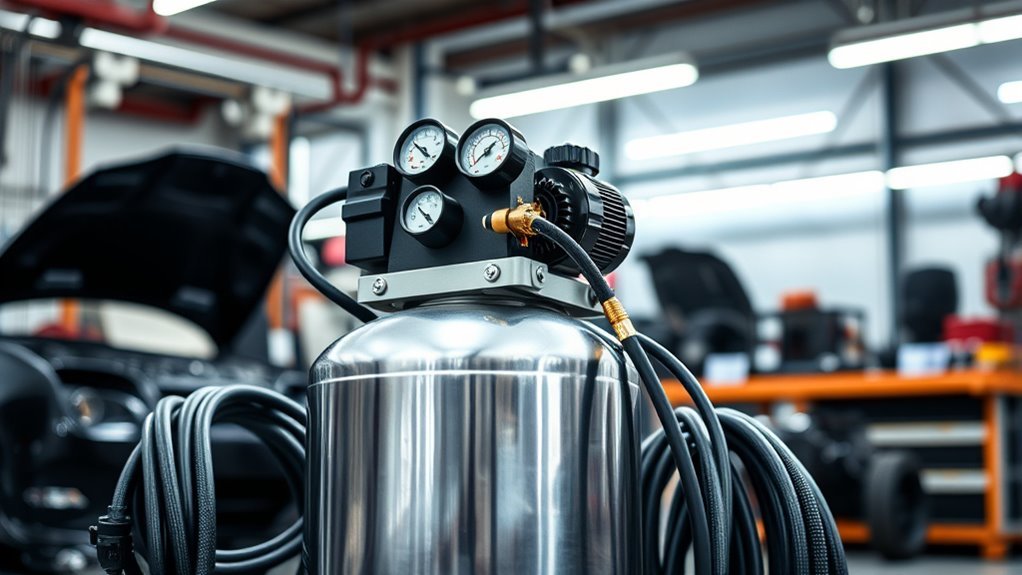
When choosing an air compressor for an auto shop, we need to weigh factors like power and pressure requirements to handle various tools efficiently. It’s also important to evaluate airflow capacity, portability, noise levels, and how easy the unit is to maintain and last over time. By focusing on these points, we can select a compressor that meets our shop’s specific needs effectively.
Power and Pressure Needs
Choosing the right air compressor hinges on understanding the power and pressure needs of your auto shop. You need to verify the compressor provides enough PSI—typically around 90-150—to support your most demanding tools. It’s also important to contemplate the CFM rating at specific PSI levels so it can run multiple tools simultaneously without lag. Matching the compressor’s horsepower and tank capacity to your workload helps maintain consistent performance and an adequate air supply. For heavy-duty tasks, a higher PSI, like 200, can be advantageous, but only if your tools are compatible. Additionally, selecting a compressor with adjustable pressure settings allows you to optimize performance for various tasks, making your shop more efficient and ensuring each tool operates at its best.
Airflow Capacity Requirements
To guarantee your auto shop runs smoothly, it’s vital to pay close attention to an air compressor’s airflow capacity, measured in CFM at specific PSI levels. This measurement indicates how much air the compressor can deliver for your tools’ operation. For auto shops, a compressor with at least 4 CFM at 90 PSI is recommended to run multiple pneumatic tools simultaneously without performance drops. Higher airflow capacity allows tools to operate longer and reduces the need for frequent recovery time. Selecting a compressor with sufficient CFM ensures consistent performance, especially with high-demand tools like impact wrenches and spray guns. Underestimating airflow needs can cause tool inefficiency, increased wear, and workflow delays, hampering your shop’s productivity.
Portability and Size
The size and portability of an air compressor play a crucial role in how efficiently your auto shop operates. Smaller, lightweight compressors are easier to move around, which boosts workflow and reduces fatigue for your team. Compact designs, like pancake-style models, often weigh under 45 pounds, making them highly portable and simple to reposition as needed. Larger tanks provide more air volume but tend to be bulkier, potentially limiting mobility in tight spaces. Many portable compressors come with built-in handles or wheels, enabling quick and effortless transportation between work areas. When choosing a compressor, it’s essential to evaluate your shop’s layout—select a size that fits comfortably without obstructing movement or workspace. Proper sizing and portability can streamline operations and enhance overall efficiency.
Noise Level Considerations
Noise levels are a critical factor when selecting an air compressor for your auto shop, as loud equipment can disrupt workflow and create an uncomfortable environment. Compressors measured below 80 dB are preferable, as they help reduce workplace noise pollution. Anything above 85 dB can pose hearing risks over time, so prioritizing quieter models is essential for safety. Oil-free compressors tend to operate more quietly because they have fewer moving parts and less mechanical noise. Additionally, choosing compressors with noise-dampening features like mufflers or sound-insulating enclosures can make a significant difference in operational noise levels. By considering these factors, we can guarantee a safer, more comfortable shop environment that complies with local noise regulations and supports efficient work.
Maintenance and Durability
Choosing a durable air compressor for your auto shop requires careful consideration of maintenance needs and construction quality. Regular upkeep, like draining moisture and checking oil levels, is crucial for extending the compressor’s lifespan and maintaining steady performance. An oil-free system can cut down on maintenance costs and reduce the need for oil changes, boosting long-term durability. Using high-quality materials such as steel tanks and corrosion-resistant components ensures the compressor can handle daily wear and environmental challenges. A high-duty cycle capability allows continuous operation without overheating or failure, essential for busy auto shops. Features like automatic shut-off, overload protection, and automatic drain valves further enhance safety and protect the unit from damage, ultimately increasing its reliability and longevity.
Compatibility With Tools
When selecting an air compressor for your auto shop, it’s essential to match its specifications with the tools you plan to use. Confirm the compressor’s CFM rating meets or exceeds your tools’ air flow requirements to maintain peak performance. Check that the maximum PSI is suitable for demanding tools like spray guns or framing nailers. Verify the connection fittings are compatible with your tools’ air inlet sizes to ensure a proper fit. Consider whether the compressor’s duty cycle can handle continuous or repeated use without overheating or pressure drops. If you plan to operate multiple tools simultaneously, opt for a model with dual quick couplers for efficient workflow. Matching your compressor’s specs with your tools will enhance performance and boost productivity.
Safety Features Included
Have you considered the safety features integrated into an air compressor before making a purchase? These features are vital for a safe, reliable operation in any auto shop. Automatic shut-off mechanisms help prevent overpressure, reducing the risk of accidents. Pressure relief valves are essential—they release excess pressure to avoid tank rupture or damage. Automatic drain valves minimize moisture buildup, preventing corrosion and guaranteeing consistent airflow. Overheating protection safeguards the motor from damage and lowers fire risk. Additionally, noise reduction features like mufflers or soundproof enclosures create a safer, more comfortable workspace. Prioritizing these safety functions ensures that the compressor operates smoothly, minimizes hazards, and protects both your team and equipment during daily use.
Budget and Cost
Considering safety features is essential, but it’s equally important to evaluate the cost and budget when selecting an air compressor for your auto shop. We recommend setting a clear budget to narrow options and prevent overspending on unnecessary features. Comparing prices for models with similar specs helps guarantee you get the best value. Don’t forget to factor in long-term costs like maintenance and energy use, which can considerably impact overall expenses. Focus on compressors that provide essential features within your budget, avoiding costly upgrades that don’t add value. While higher-priced models may cost more upfront, they often offer better durability and performance, potentially saving money on replacements down the line. Balancing upfront costs with long-term reliability is key to making a smart investment.
Frequently Asked Questions
How Do I Maintain and Service Different Types of Air Compressors?
We regularly check and change compressor oils, clean filters, drain moisture, and inspect belts and hoses. Following manufacturer guidelines for each type guarantees efficient operation, prolongs lifespan, and prevents costly breakdowns in our auto shop.
What Safety Precautions Should I Follow When Operating Air Compressors?
In this day and age, we prioritize safety by wearing protective gear, inspecting equipment regularly, avoiding overloading, keeping vents clear, and following manufacturer instructions closely. We always double-check safety features before operating compressors.
Can I Use One Air Compressor for Multiple Auto Shop Tools?
Yes, you can use one air compressor for multiple tools, but make sure it has enough CFM and pressure capacity. We always recommend installing proper hoses and quick-connect fittings to switch tools efficiently and safely.
How Do I Troubleshoot Common Air Compressor Problems?
Like a seasoned detective, we check for leaks, verify proper oil levels, and clean filters, as these simple steps help us quickly identify and fix common air compressor problems, keeping our auto shop running smoothly.
What Is the Typical Lifespan of Various Air Compressor Models?
Typically, air compressors last 10 to 15 years, but quality models with proper maintenance can exceed this. We recommend regular inspections, oil changes, and cleaning to maximize lifespan and guarantee reliable performance in your auto shop.
Conclusion
Choosing the right air compressor is essential for keeping our auto shop running smoothly. With options like portable pancake models for light tasks and high-capacity units for demanding jobs, we can find the perfect fit. Remember, “a penny saved is a penny earned,” so investing in quality guarantees safety, efficiency, and longevity. By understanding your needs, you’ll keep your shop efficient and your tools happy.