Ad Blocker Detected
Our website is made possible by displaying online advertisements to our visitors. Please consider supporting us by disabling your ad blocker.
Imagine restoring a vintage car engine or inflating multiple tires quickly during a busy day—that’s where the right air compressor really makes a difference. We’ve tested various models to find the top-rated options for every job, from quiet, portable units to heavy-duty machines. But how do you choose the best one for your needs? Keep going, and we’ll guide you through the key features and must-know factors to make an informed decision.
Key Takeaways
- Choose compressors with appropriate CFM, PSI, and horsepower for different job requirements and tool compatibility.
- Prioritize models with durable construction, high-quality pumps, and low maintenance needs for longevity.
- Consider portability features like size, weight, and tank capacity for easy transport and extended use.
- Select quiet operation models for indoor or noise-sensitive environments, with noise levels below 80 dBA.
- Look for versatile features such as preset pressures, accessories, and fast inflation capabilities for various tasks.
DEWALT Pancake Air Compressor, 6 Gallon, 165 PSI (DWFP55126)
The DEWALT Pancake Air Compressor, with its 6-gallon tank and 165 PSI maximum pressure, stands out as an ideal choice for both DIY enthusiasts and professionals who need a portable, reliable air supply. Its oil-free pump delivers 2.6 SCFM at 90 PSI, supporting long tool run times and quick recovery. Weighing just 30 pounds, its compact, rectangular design makes it easy to carry and store. Features like a cord wrap, removable console cover, and rerouted outlet tube enhance usability and durability. With quiet operation at around 78.5 dBA, it’s perfect for various work environments, providing steady power for pneumatic tools and spray applications.
Best For: DIY enthusiasts and professionals seeking a portable, reliable air compressor for pneumatic tools, spray applications, and extended use in various work environments.
Pros:
- Compact and lightweight design at only 30 pounds, making it easy to transport and store.
- Quiet operation at approximately 78.5 dBA, suitable for use in noise-sensitive environments.
- Oil-free pump requires minimal maintenance and supports long runtime with quick recovery.
Cons:
- Limited tank capacity of 6 gallons may require longer breaks for larger continuous tasks.
- Slightly higher noise level compared to some ultra-quiet models, which might be noticeable in very quiet settings.
- The 5-meter hose length may be restrictive for some larger workspace setups.
California Air Tools 1-Gallon Portable Quiet Air Compressor
Ideal for noise-sensitive environments, the California Air Tools 1-Gallon Portable Quiet Air Compressor operates at just 56 decibels. Its lightweight design, weighing only 29 pounds, makes it easy to transport for various tasks. Powered by a 0.6 HP motor running at 1680 RPM, it delivers reliable performance with minimal noise and wear. The oil-free dual piston pump guarantees durability, lasting over 3,000 hours with little maintenance. Suitable for inflating tires, powering airbrushes, or stapling, it offers 1.20 CFM at 90 PSI. Its compact size and quiet operation make it perfect for indoor use, hobby projects, or any noise-sensitive setting.
Best For: DIY enthusiasts, hobbyists, and professionals needing a quiet, portable air compressor for indoor tasks and noise-sensitive environments.
Pros:
- Operates at a very low noise level of 56 decibels, ideal for indoor use.
- Lightweight and portable at only 29 pounds, easy to transport.
- Durable oil-free dual piston pump with a lifespan exceeding 3,000 hours with minimal maintenance.
Cons:
- Limited tank capacity of 1 gallon, which may require frequent refilling for larger tasks.
- Maximum airflow of 1.60 CFM at 40 PSI, which might not be suitable for heavy-duty applications.
- Slightly higher price point compared to larger or less quiet compressors with similar power.
9600mAh Portable Tire Inflator with Battery & DC
For those seeking a reliable, portable inflator, the 9600mAh Tire Inflator with Battery & DC offers quick, cordless operation for roadside emergencies. It inflates car tires from 29 to 36 PSI in just a minute, with a maximum pressure of 160 PSI and airflow of 30L/min. Its dual power options—cordless battery and 12V DC—provide flexibility, while the LCD display and preset modes make inflating various tires and inflatables straightforward. With a 30-minute runtime per charge and safety features like auto shut-off and a built-in LED light, it’s a dependable tool to keep in your vehicle for any inflating needs.
Best For: individuals who need a reliable, portable inflator for roadside tire emergencies, outdoor activities, or regular inflating tasks with quick, cordless operation and safety features.
Pros:
- Fast inflation capability, inflates car tires from 29 to 36 PSI in just 1 minute.
- Dual power sources (cordless battery and 12V DC) for versatile use anywhere.
- Built-in safety features, including auto shut-off and LED emergency light, enhance safety and convenience.
Cons:
- Runtime of approximately 30 minutes may require recharging for multiple inflations.
- Slightly bulky design could be less portable for tight storage spaces.
- Limited to 30-minute sessions per charge, which might be insufficient for inflating many items continuously.
Craftsman 2-Gallon Portable Air Compressor with Accessories
This compact Craftsman 2-Gallon Portable Air Compressor is perfect for DIYers and professionals needing reliable power on the go. Weighing about 19 pounds with a durable metal build, it’s easy to transport thanks to its rubber-reinforced handle. Its 1/3 HP motor delivers up to 125 PSI with stable airflow and low energy use. The oil-free pump requires no maintenance, and features like heat dissipation and overload protection boost durability. It comes with a versatile accessory kit, including an air hose, blow gun, tire pressure gauge, and more, making it suitable for tasks like tire inflation, painting, and carpentry.
Best For: DIY enthusiasts and professionals seeking a portable, reliable air compressor for various tasks like tire inflation, painting, and carpentry.
Pros:
- Lightweight and compact design for easy transportation and storage
- Oil-free pump system requiring minimal maintenance
- Versatile accessory kit suitable for multiple applications
Cons:
- Noise level of approximately 78 decibels may be disruptive in quiet environments
- Limited tank capacity (2 gallons) may require frequent refilling for continuous use
- Slightly lower maximum horsepower (0.33 HP) compared to larger models for heavy-duty tasks
SAMOUT 12V Portable Air Compressor with LCD Display
The SAMOUT 12V Portable Air Compressor with LCD Display stands out for its powerful performance and user-friendly features, making it perfect for off-road enthusiasts and heavy-duty vehicle owners. Its dual-cylinder design, LCD screen, and preset pressure controls allow for precise inflation of large tires like those on 4x4s, SUVs, and RVs. With a maximum pressure of 150 PSI and the ability to inflate five tires in under 7 minutes, it’s both efficient and reliable. The compressor’s durable build, 26.25-foot hose, and 2-year warranty guarantee it’s ready for tough environments, providing peace of mind during every use.
Best For: off-road enthusiasts, heavy-duty vehicle owners, and those needing quick, reliable inflation for large tires like 4x4s, SUVs, and RVs.
Pros:
- High maximum pressure of 150 PSI and fast inflation capability, inflating five 31-inch tires in under 7 minutes
- Durable construction with copper components and a heavy-duty design suitable for tough environments
- User-friendly digital LCD display with preset pressure controls for precise, automated inflation
Cons:
- Relatively heavy at approximately 11 kg, which may affect portability for some users
- Noise level of 78 decibels could be loud during operation
- Limited to 12V power sources, requiring access to a compatible vehicle outlet
Factors to Consider When Choosing Rated Air Compressors
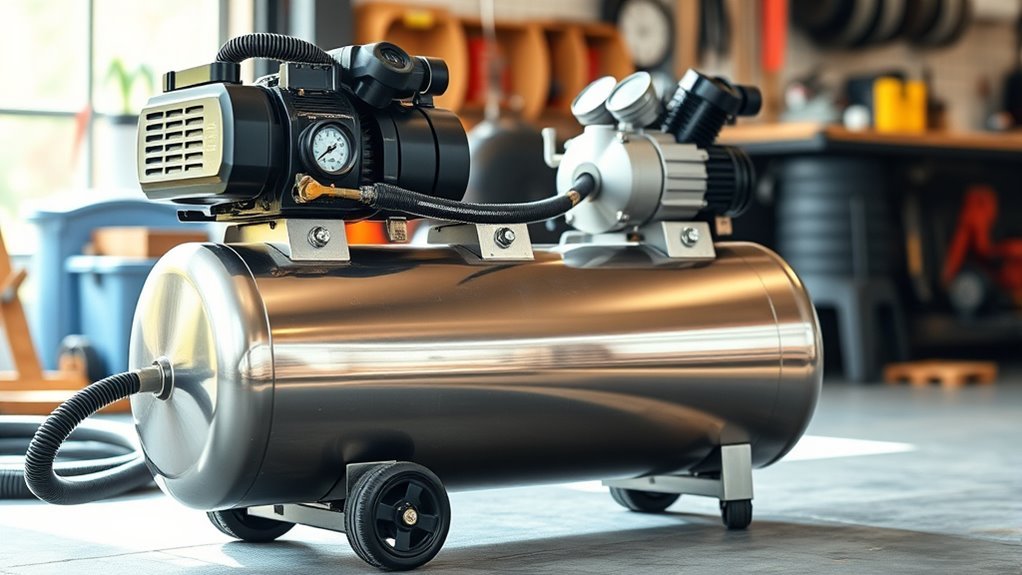
When selecting an air compressor, we need to take into account several key factors to ensure it fits our needs. These include power and performance, portability, noise levels, tank capacity, and durability. Understanding these points helps us choose the right compressor for any task.
Power and Performance
Choosing the right air compressor hinges on understanding its power and performance capabilities. Power is typically measured in horsepower (HP), with higher HP units suited for demanding tasks. Performance depends on the maximum PSI, which determines the pressure capacity for different applications. Airflow capacity, expressed in CFM, indicates how fast the compressor can supply air to tools, affecting efficiency. The duty cycle shows how long the compressor can run continuously without overheating, impacting consistent performance during prolonged use. Additionally, the pump type—oil-free or oil-lubricated—affects durability and maintenance needs. A well-rounded compressor balances horsepower, PSI, CFM, duty cycle, and pump quality, ensuring it can handle your specific jobs reliably and efficiently.
Portability and Size
Considering the physical size and weight of an air compressor is essential for ensuring it fits your workspace and is easy to transport. Smaller, lightweight models are perfect for portability, especially if you need to move between job sites frequently. Features like built-in handles, wheels, and compact designs can greatly enhance ease of transport without sacrificing performance. Keep in mind that smaller tanks are easier to carry but may need refilling more often for continuous tasks. It’s important to find a balance between size and capacity, making sure the compressor meets your specific needs. If you prioritize mobility, choose a lightweight model with convenient features, but don’t forget to take into account whether its size and tank capacity align with your workload.
Noise Levels
Noise levels are a crucial factor because they directly impact comfort and safety during operation. Lower noise levels make indoor use more practical and reduce disturbance in noise-sensitive areas. Typically, compressors produce between 56 dBA and over 78 dBA, with quieter models around 56-70 dBA. A compressor below 70 dBA is generally considered quiet, suitable for professional or home environments. The noise output depends on the type of pump, motor design, and sound insulation features. High noise levels above 80 dBA can cause discomfort or hearing damage over time, highlighting the significance of selecting a quieter model. By considering noise levels, we guarantee safer, more comfortable operation, especially in environments where noise pollution is a concern.
Tank Capacity Needs
Tank capacity plays a vital role in how effectively an air compressor can handle your tasks, especially when you need continuous airflow. A larger tank, like 6 gallons or more, is ideal for heavy-duty jobs such as framing or roofing, providing longer run times without frequent stops. Smaller tanks, around 1 gallon, suit light-duty tasks or portable use, reducing weight and bulk. The right tank size depends on your tools’ air consumption rates—larger tanks offer more sustained airflow and minimize compressor cycling, boosting efficiency. However, overestimating capacity can add unnecessary weight, while underestimating may mean more frequent restarts, impacting productivity. Matching tank capacity to your specific needs guarantees you get reliable, consistent performance without excess bulk or downtime.
Durability and Build
Durability and build quality are essential factors when selecting a rated air compressor because they directly influence its lifespan and reliability. We look for models with sturdy construction, using high-quality materials like metal or reinforced plastic to withstand frequent use and tough environments. The pump type also matters; oil-free pumps are low-maintenance but may not last as long as oil-lubricated ones. Reinforced components, such as heavy-duty tanks and corrosion-resistant coatings, help prevent wear and extend service life. Secure fittings and reinforced outlets reduce leaks and component failures, ensuring consistent performance. Additionally, a robust design often includes safety features like overload protection and thermal switches, which safeguard the compressor from damage caused by overheating or excessive pressure.
Maintenance Requirements
When selecting a rated air compressor, understanding its maintenance requirements helps guarantee it stays reliable and efficient over time. Regular upkeep includes checking and replacing air filters, monitoring oil levels if applicable, and draining moisture from tanks to prevent rust and corrosion. Oil-free compressors demand less maintenance but still need periodic inspection of seals and valves to maintain performance. The frequency of these tasks varies with usage; heavy-duty use might require weekly checks, while light use could mean monthly inspections. Proper maintenance not only prolongs the compressor’s lifespan but also ensures maximum operation. Monitoring parameters like pressure, temperature, and noise levels can help identify early signs of wear or malfunction, allowing timely intervention and avoiding costly breakdowns.
Compatibility and Accessories
Choosing the right air compressor involves guaranteeing it is compatible with your tools and intended applications. We need to check if it works with the tools we plan to use, like spray guns, nailers, or inflators. It’s also important to verify the availability of accessories such as hoses, couplers, and adapters that match the compressor’s fittings. Some models include or support extra attachments like pressure gauges or quick-connect fittings, which can enhance functionality. We should confirm that the compressor’s power source and voltage requirements align with our electrical setup or vehicle outlets. Lastly, evaluating whether the compressor’s maximum pressure and airflow meet our specific needs ensures it performs effectively and handles the tasks efficiently.
Price and Warranty
Evaluating the price and warranty of an air compressor helps guarantee you’re making a smart investment. A longer warranty often signals higher product reliability and confidence from the manufacturer, so it’s worth considering. Compare the cost of the compressor with its warranty coverage to ensure you’re getting good value, especially if pricier models include extended warranties. Keep in mind that some lower-cost compressors might have limited or no warranty, which could lead to higher repair or replacement costs down the line. Check what the warranty covers—parts, labor, and accidental damage—to understand potential out-of-pocket expenses. A thorough warranty provides peace of mind and can save you money over the compressor’s lifespan, particularly for heavy-duty or frequently used tools.
Frequently Asked Questions
How Do Noise Levels Vary Among Different Air Compressor Models?
Noise levels vary among models, with some designed for quiet operation and others producing louder sounds. We find that inverter and oil-free compressors tend to be quieter, making them ideal for noise-sensitive environments or indoor use.
What Maintenance Is Required for Long-Term Compressor Performance?
We keep our compressors humming smoothly by regularly checking and changing oil, inspecting hoses for wear, cleaning filters, and draining moisture. This routine helps guarantee reliable performance and prolongs the life of our equipment, mate.
Are There Safety Features Included in These Compressors?
Yes, these compressors include safety features like pressure relief valves, thermal overload protection, and automatic shut-off systems. We guarantee safety by regularly checking these features and following manufacturer guidelines, so you stay protected during every use.
Can These Compressors Handle Continuous, Heavy-Duty Work?
Seventy-five percent of heavy-duty compressors operate continuously without overheating, and we’re confident these models can handle nonstop, demanding tasks thanks to their robust construction, high CFM ratings, and reliable thermal management systems.
How Do Power Sources Affect Compressor Portability?
Power sources greatly impact compressor portability; electric models are lightweight and easy to move indoors, while gas-powered units offer mobility in remote locations but tend to be heavier and bulkier. Choose based on your specific job needs.
Conclusion
Choosing the right air compressor is like finding the perfect tool in a toolbox — it makes every job smoother and more efficient. Whether we need quiet operation or heavy-duty power, there’s a model that fits our needs. By considering factors like size, noise, and performance, we can guarantee our investment pays off. After all, the right compressor is the steady heartbeat that keeps our projects alive and thriving.